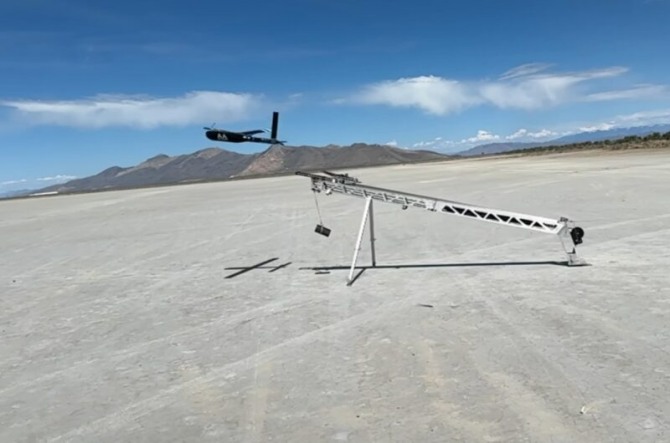
KIHOMAC Agami drone cuts production time to 1 hour per unit, opens Utah mass-production facility with Deloitte backing
Originally reported by g-enews.com
KIHOMAC, a US aerospace and defense startup founded by former US Air Force lieutenant colonel Kiho Kang, has unveiled the Agami fixed-wing drone under Project Liberty, claiming a per-unit production time of under one hour using carbon fiber construction. The 20-pound (9 kg) aircraft carries a 5-pound (2.2 kg) payload via an open-architecture bring-your-own-payload design, achieves 60 miles (96 km) of range on a single battery pack and up to 90 miles (145 km) with two packs, and launches via catapult without a runway. In November 2025, Deloitte made a direct investment in KIHOMAC to expand manufacturing capacity in Utah, targeting mass production for US government agencies, enterprises, and organizations. The investment amount was not disclosed.
This development directly challenges the prevailing assumption that additive manufacturing is the fastest path to drone production at scale. KIHOMAC explicitly frames its carbon fiber hand-layup or automated fiber placement approach as 100x faster than 3D-printed drone alternatives, which the company states can require over 100 hours per airframe. The argument lands squarely in the defense procurement debate accelerated by the Ukraine conflict, where consumption rates of small unmanned systems have outstripped any pre-war production forecast. KIHOMAC is betting that for commanders in a high-intensity conflict, a replaceable airframe built in one hour is more valuable than a higher-performance platform that takes days or weeks to replace. The Deloitte partnership adds credibility and capital access, and the Utah facility positions KIHOMAC to serve US-only supply chain requirements, aligning with legislative pushes to reduce reliance on Chinese drone components.
From an AM industry perspective, KIHOMACs claim is a useful stress test for the value proposition of additive manufacturing in defense applications. If the company can deliver reliable, mission-capable drones at the claimed production rate and cost, it will force AM proponents to sharpen their arguments beyond speed alone, toward the specific advantages of design iteration, part consolidation, or material properties that justify longer build times. For now, the burden is on KIHOMAC to demonstrate that sub-one-hour carbon fiber airframes meet military reliability and performance standards in operational testing, not just in marketing videos.
This article is an AI-assisted rewrite of the linked source report. Facts originate from the source; phrasing is AMPulse's. Use Read Original below to verify, or Report an issue if something is wrong.