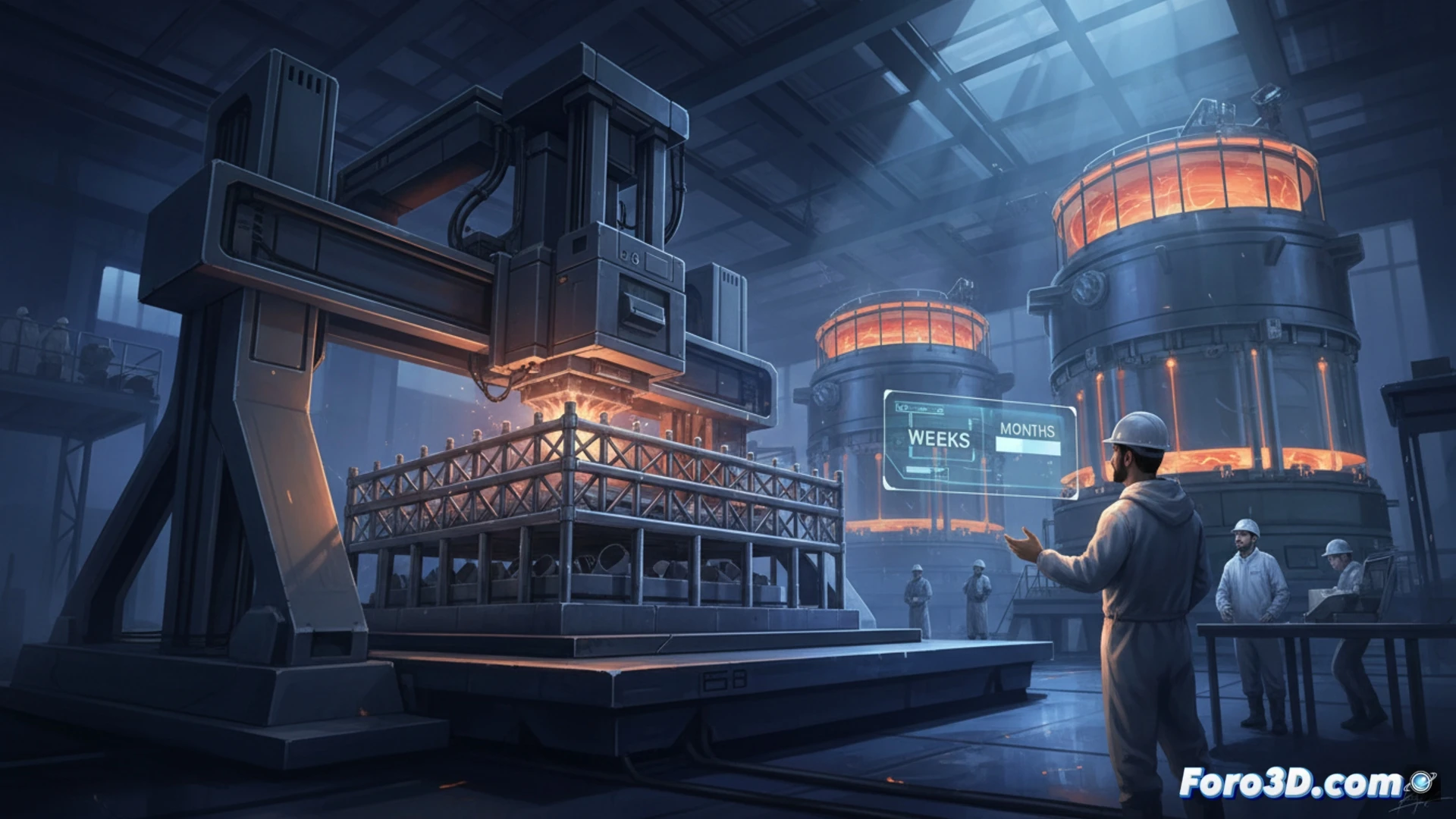
ORNL deploys large-format 3D printing to cut nuclear reactor construction from months to weeks
Originally reported by foro3d.com
Oak Ridge National Laboratory (ORNL) is applying large-format additive manufacturing to nuclear reactor construction, led by researcher Ahmed Arabi Hassan. The project targets structural components for the first molten-salt reactor in the United States, located at the historic K-25 site in Tennessee. ORNL uses polymer and ceramic composite materials in large-scale printers to build complex internal shielding and curved cooling channels that cannot be formed with concrete molds. The approach eliminates tooling, reduces material waste, and achieves dimensional precision superior to manual processes, compressing fabrication timelines from months to weeks.
This work sits at the intersection of two underappreciated AM demand verticals: energy and large-format tooling. The energy sector, particularly nuclear, has been fragmented and early in AM adoption, but ORNL's project demonstrates a concrete path to serial production for safety-critical, geometrically complex components. The technology - large-format polymer and ceramic composite extrusion - is distinct from the metal PBF and DED processes typically associated with nuclear applications. By targeting concrete-replacement parts, ORNL is addressing a structural bottleneck in reactor construction where traditional formwork imposes both time and geometric constraints. The project also aligns with the broader U.S. push to accelerate advanced reactor deployment, where AM's ability to reduce lead times and enable novel geometries could become a strategic advantage.
From an expert standpoint, this is a practical demonstration of AM solving a specific, high-value manufacturing problem rather than a broad technology proclamation. The key execution risk is qualification: nuclear-grade components require rigorous certification, and ORNL must demonstrate that additively manufactured polymer-ceramic parts meet radiation, thermal, and structural standards over reactor lifetimes. If successful, the project will provide a template for AM adoption in other regulated energy infrastructure, but the path from prototype to embedded production remains measured in years, not print cycles.
Topics