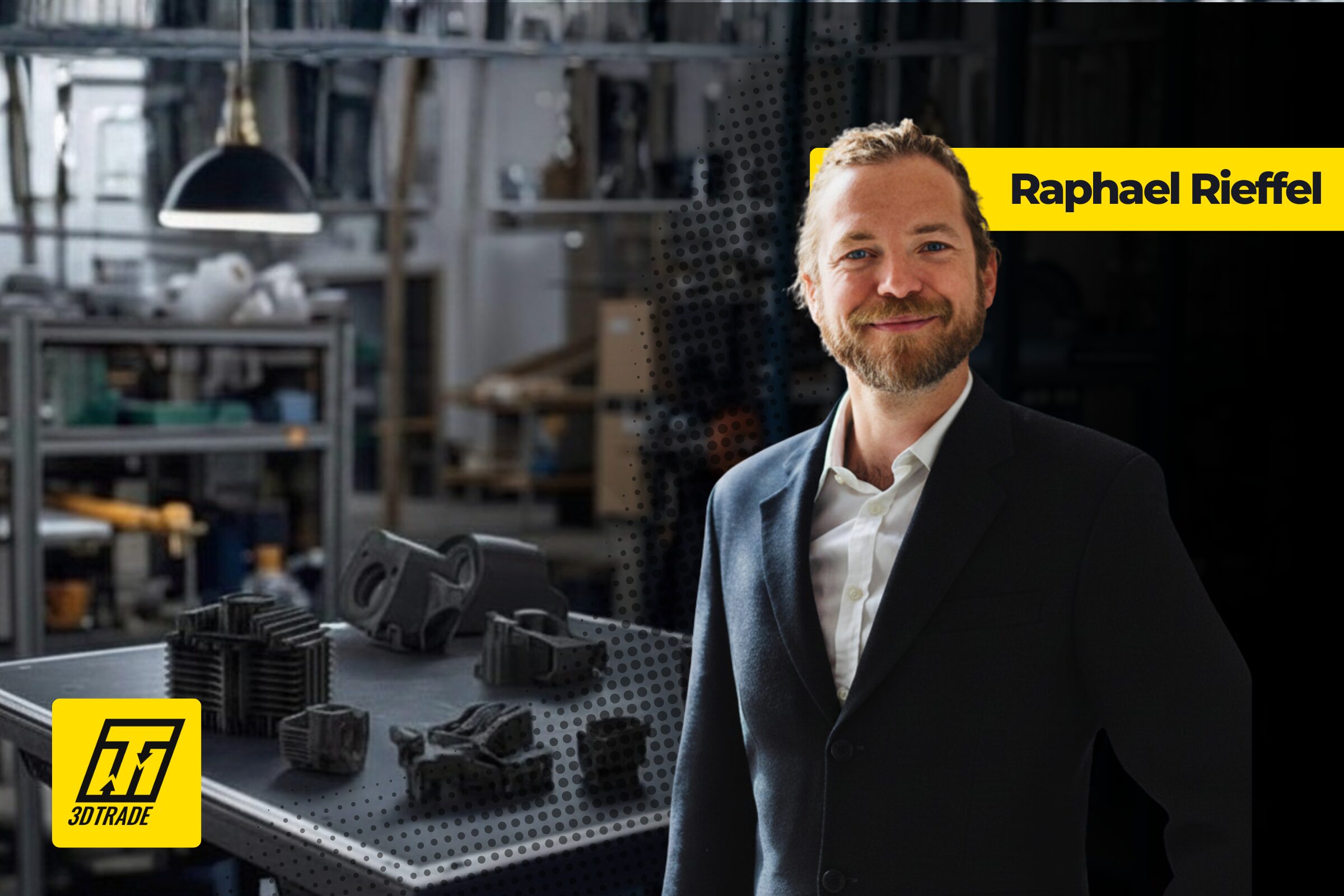
3D-Trade positions as system integrator bridging Chinese AM hardware to European industrial users

Service
Originally reported by 3Druck
German company 3D-Trade has formally positioned itself as a system integrator for industrial additive manufacturing, targeting companies that want to move beyond prototyping into production-ready processes. Managing Director Raphael Rieffel outlined the strategy in a recent interview, emphasizing the firm's role in technology selection, material qualification, process integration, and local technical support. 3D-Trade distributes industrial 3D printing systems for polymer processes including selective laser sintering (SLS), stereolithography (SLA), and pellet extrusion, covering applications from prototypes and fixtures to low-volume series production. A core differentiator is its focus on open system architectures and qualification of materials outside closed OEM ecosystems, particularly in SLS where users increasingly demand control over powders, parameters, and process windows.
This positioning directly addresses a structural tension in the European AM market: Chinese hardware vendors are gaining traction with large service bureaus and mid-market manufacturers seeking cost-effective, material-open systems, but many potential buyers hesitate due to the lack of established DACH-region service and support structures. 3D-Trade acts as a local risk mitigator, offering independent evaluation, implementation support, and guaranteed spare parts and technical service. The move reflects the broader Chinese localization arc pattern, where Western pioneers established the category and Chinese entrants now scale with lower costs and integrated supply chains, but require credible local partners to overcome adoption barriers. For the polymer SLS segment, this model could accelerate the shift toward material-open systems that decouple machine and material purchasing decisions, potentially driving down material costs through increased competition.
From a practical standpoint, 3D-Trade's success will depend on execution: whether it can build a repeatable qualification pipeline for third-party materials and maintain service quality across multiple Chinese OEM platforms. For European buyers evaluating Chinese SLS or pellet extrusion systems, the key question is no longer whether the hardware performs, but whether the local support chain can match the reliability of established Western OEMs. 3D-Trade's model offers a test case for whether a system integrator can effectively bridge that gap at scale.
Topics