Additive Tectonics CEO Bruno Knychalla defends 3D printing potential in architecture against criticism

Hardware
Originally reported by detail.de
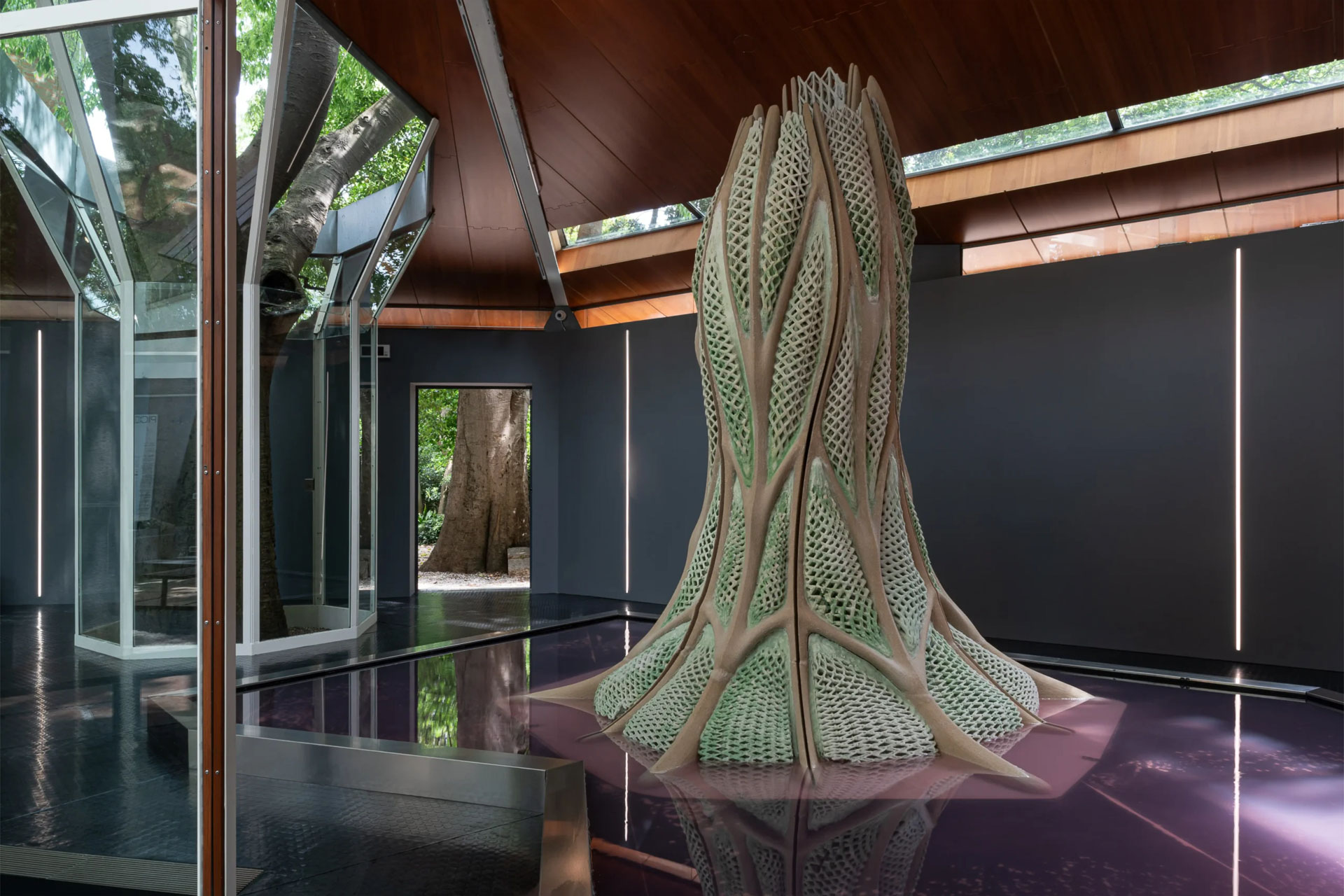
Additive Tectonics CEO Bruno Knychalla has pushed back against skepticism regarding 3D printing's viability in architecture, following a critical editorial by German publication Detail. In an interview published May 12, 2026, Knychalla cited the company's work at the 2025 Venice Architecture Biennale as evidence of practical, scalable application. Additive Tectonics, a service bureau operating under the FIT Additive Manufacturing Group, produced approximately 400 3D-printed columns for the main exhibition curated by Carlo Ratti, serving as structural supports for display panels. The company also contributed to the Canadian Pavilion's "Picoplanktonics" installation, printing sand-based forms that hosted cyanobacteria for a photosynthetic hardening process, developed in collaboration with ETH Zurich material scientists.
This exchange updates a recurring tension within the AM industry: the gap between technical capability and architectural adoption. Additive Tectonics operates in a niche where polymer-based binder jetting and material extrusion are used for non-structural, form-driven elements - a segment that remains economically small compared to industrial tooling or aerospace production. The Detail critique mirrors a broader pattern where AM in architecture is often dismissed as an exhibition gimmick, yet the Biennale deployment shows that 3D-printed components can function as invisible infrastructure rather than spectacle. The company's interdisciplinary team of 15 - spanning architecture, mechanical engineering, materials science, and carpentry - reflects the bespoke, project-based service model that dominates this vertical, where repeatable serial production is rare and each installation requires custom material development and design iteration.
From an industry perspective, this debate is less about technology readiness and more about market structure. Additive Tectonics' ability to deliver 400 identical columns for a high-profile event demonstrates production consistency, but the architectural AM segment still lacks the qualification frameworks and cost curves that drive adoption in aerospace or medical-dental. The company's access to FIT's material labs and CT scanners is a structural advantage, but scaling beyond biennale-scale projects will require either a shift toward standardized building components or a sustained pipeline of custom, high-budget installations. For now, the Detail exchange serves as a reminder that architectural AM remains a proof-of-concept market, not a production one.
This article is an AI-assisted rewrite of the linked source report. Facts originate from the source; phrasing is AMPulse's. Use Read Original below to verify, or Report an issue if something is wrong.
Topics