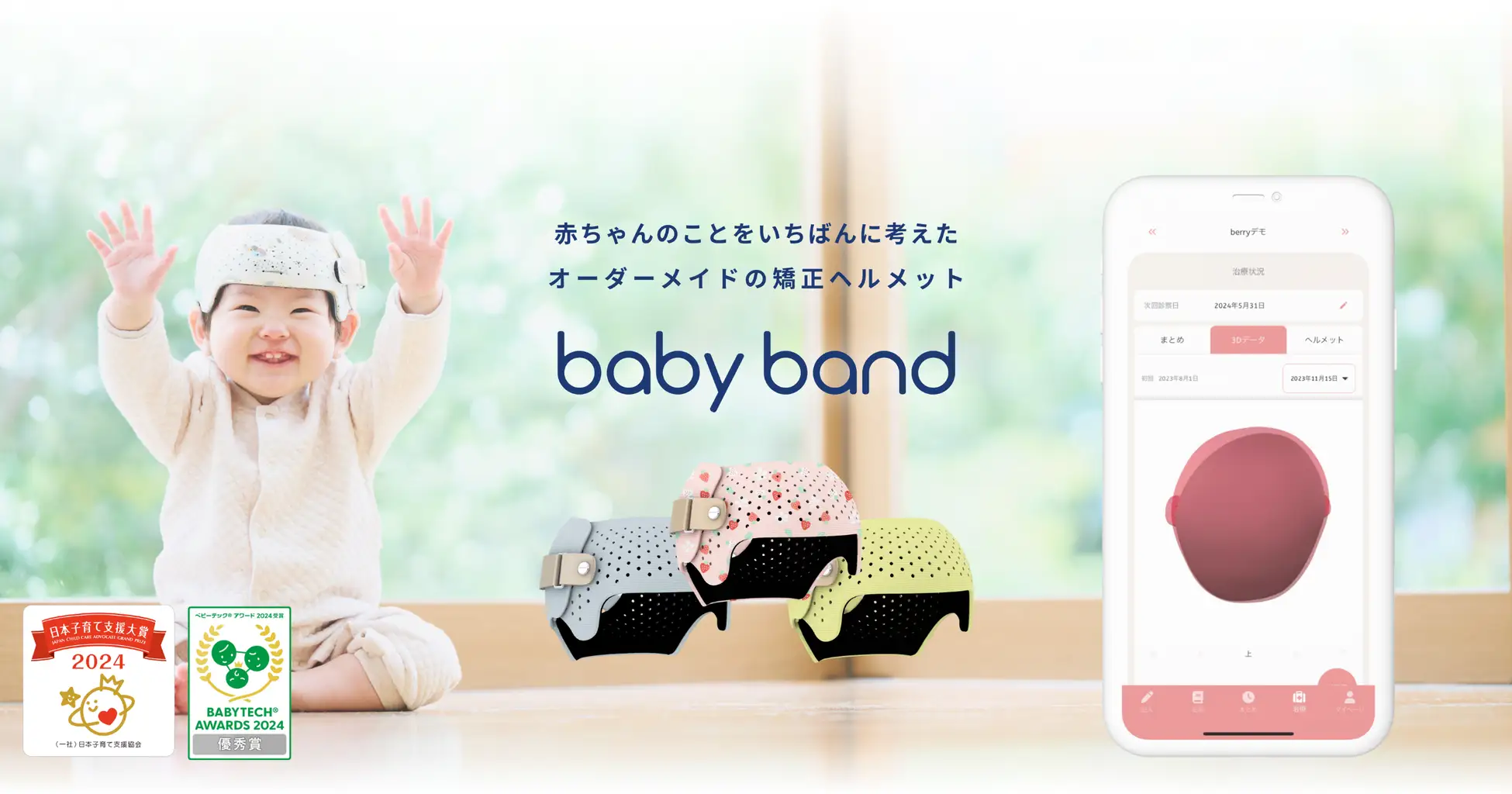
BabyBand cranial orthosis helmet wins Medtec Innovation Award, expands to 260+ hospitals across Japan

Application
Originally reported by ShareLab
BabyBand, a cranial orthosis helmet developed by Japanese medical device startup Berry, has won the Wellbeing Award at the 14th Medtec Innovation Awards, presented on April 21, 2026 at Medtec Japan in Tokyo. The 3D-printed helmet, designed to correct infant skull deformities, has been adopted by over 260 medical institutions across 41 of Japan's 47 prefectures since its market introduction in July 2022. Berry reports that BabyBand now has the largest number of clinical adoption sites among competing products in Japan as of April 28, 2026. The device is classified as a Class II medical device under Japanese regulatory approval number 30500BZX00071000.
This award signals a quiet but meaningful expansion of additive manufacturing in patient-specific medical devices, a vertical where AM's value proposition - mass customization without tooling cost - maps directly onto clinical need. BabyBand's trajectory mirrors the broader medical-dental adoption pattern: a single-product startup using vat photopolymerization or material extrusion to produce custom orthoses, scaling through clinical network effects rather than hardware sales. The product's spread to 260+ hospitals in under four years demonstrates that AM-based medical devices can achieve meaningful clinical penetration without requiring the capital intensity of metal implant qualification. The key metric here is not the award itself but the adoption density: 41 prefectures suggests BabyBand is approaching national coverage in Japan, a market where geographic access to specialized cranial orthosis treatment has historically been uneven.
For Berry, the next operational challenge is maintaining quality consistency across a distributed production model - likely centralized manufacturing with digital workflow, given the regulatory framework. The company should focus on building clinical evidence data to support reimbursement expansion, as Japanese national health insurance coverage for cranial orthoses remains limited. For AM industry observers, BabyBand represents a clean case study in how single-product medical device startups can achieve clinical scale without requiring the multi-year qualification cycles typical of aerospace or orthopedic implants. The product's success depends on continued hospital onboarding and payer adoption, not on technology breakthroughs.
Topics