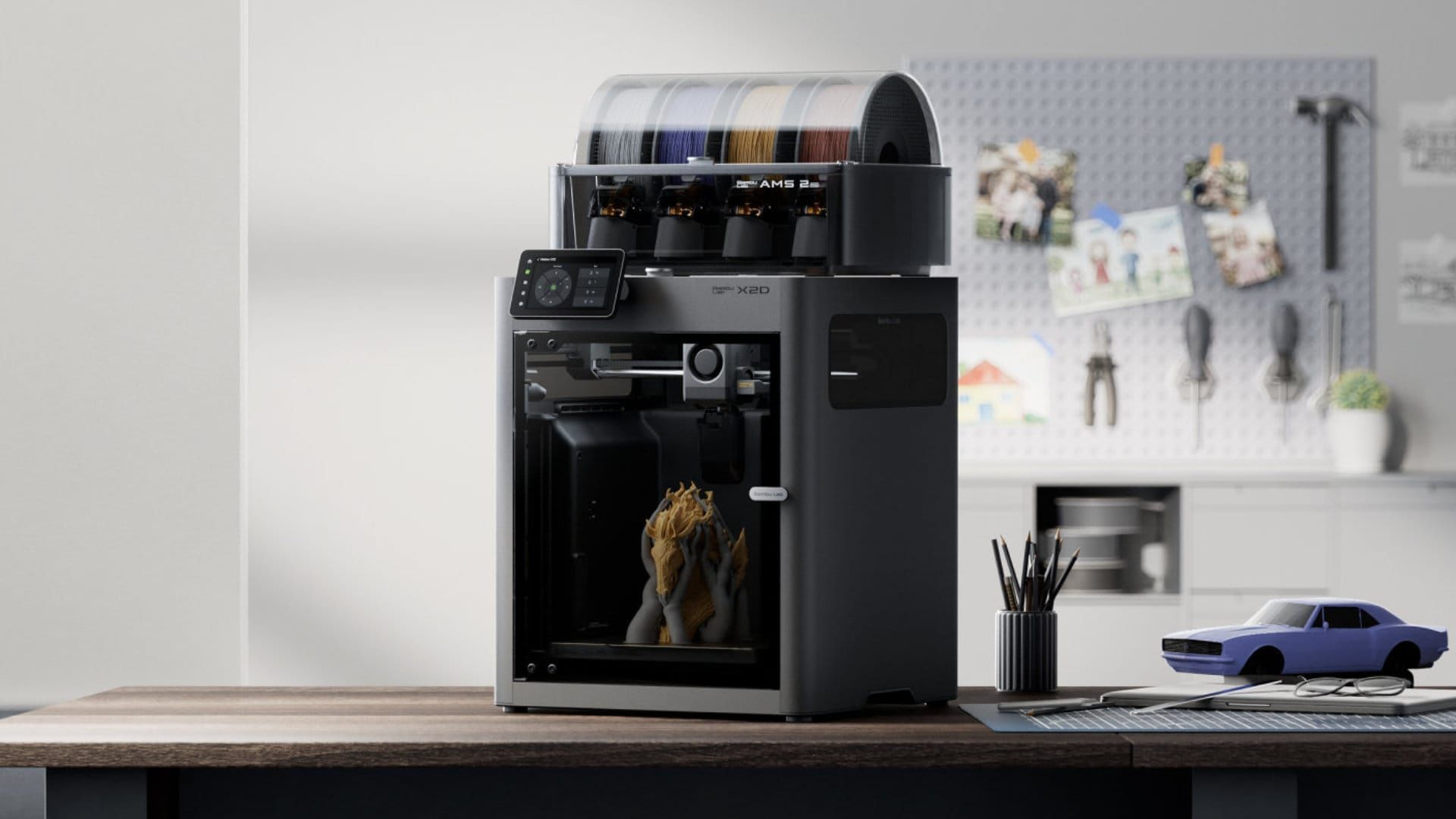
Bambu Lab launches X2D dual-nozzle 3D printer with mechanical switching, starting at $649

Hardware
Originally reported by 3D Printing Industry
Bambu Lab has introduced the X2D, the second-generation flagship in its X Series of desktop 3D printers, priced from $649. The system features a dual-nozzle extrusion head with a gear- and trigger-based mechanical switching mechanism, eliminating the need for an additional motor on the toolhead. One nozzle is dedicated to model material via a direct-drive extruder, while the second handles support material through a rear-mounted Bowden extruder, enabling higher feeding force. The printer includes Dynamic Flow Calibration, which monitors extrusion motor torque and nozzle condition at 20 kHz to compensate for wear and environmental variation before each print. The chamber reaches 65°C with nozzle temperatures up to 300°C, supporting engineering-grade materials such as ABS alongside PLA.
This launch addresses two persistent pain points in desktop polymer AM: post-processing labor and material waste during multi-material printing. By dedicating a separate nozzle to support material, Bambu Lab reduces the need for manual finishing and surface damage common in single-nozzle purge-based systems. The mechanical switching approach, tested beyond one million cycles, avoids the added mass and vibration of a second motor, preserving print stability. This positions the X2D as a workflow-focused upgrade rather than a speed race, targeting users who have adopted desktop AM for functional prototyping and short-run production but remain frustrated by support removal and purge waste. The $649 price point keeps it competitive against Prusa Research's MK4 and Creality's K-series, while the dual-nozzle architecture differentiates it from Bambu's own X1 Carbon, which relied on filament purging for multi-material jobs.
For Bambu Lab, the X2D represents a logical evolution of its platform strategy: retain the enclosed, automated calibration foundation of the X1 series while solving the specific material-handling constraints that limit desktop AM adoption in engineering workflows. The company must now demonstrate that the mechanical switching mechanism maintains reliability across diverse material combinations and that the Bowden-fed auxiliary nozzle does not introduce stringing or retraction issues at speed. Buyers evaluating the X2D should verify that their preferred support materials are compatible with the 300°C nozzle limit and that the dual-thermal mode switching meets their part geometry requirements.
This article is an AI-assisted rewrite of the linked source report. Facts originate from the source; phrasing is AMPulse's. Use Read Original below to verify, or Report an issue if something is wrong.
Topics