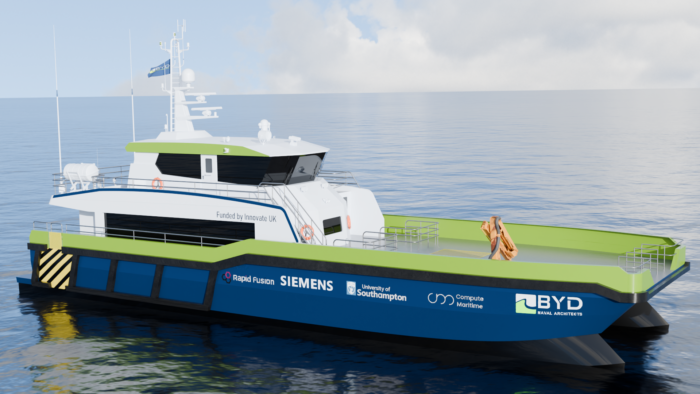
Compute Maritime and partners reveal AI-designed crew transfer vessel saving 101,671 litres of fuel per year

Software
Originally reported by dredgewire.com
Compute Maritime, the London-based developer of the NeuralShipper AI platform for ship design, has unveiled the results of its UK Government-funded GenDSOM project, produced in partnership with Siemens Digital Industries Software, Rapid Fusion, HP, BYD Naval Architects, and the University of Southampton. The consortium designed a 32.5-metre twin-hull crew transfer vessel (CTV) for the offshore wind sector that, according to detailed performance modelling, saves 101,671 litres of fuel and 258.7 tonnes of CO₂ per vessel per year compared to a conventional baseline. The hull form, optimised by NeuralShipper, reduces required power at the 25-knot service speed by 6.3%, with reductions of up to 11.6% at higher speeds. The project also produced a working hydrofoil component using Rapid Fusion's Apollo robotic large-format additive manufacturing (LFAM) system, demonstrating a direct pipeline from AI-generated geometry to a production-ready marine part.
This project matters because it bridges two of the hardest gaps in industrial additive manufacturing: embedding production constraints directly into generative design, and proving that AI-optimised geometry can deliver measurable operational savings rather than just theoretical improvements. The CTV case is particularly instructive - the NeuralShipper-optimised vessel ends a full operating day with a 106 kWh battery surplus, while the baseline vessel finishes with a 34 kWh deficit, meaning the AI optimisation does not merely improve efficiency but makes the hybrid-electric propulsion system viable in the first place. The LFAM hydrofoil, designed with build-volume and support-structure constraints integrated into the NeuralShipper loop, avoids the common pitfall of designing for performance and then struggling to manufacture. For the marine sector, which has been a slow adopter of AM beyond prototyping and spare parts, this represents a rare end-to-end demonstration from generative design through to a production component.
From a practical standpoint, the GenDSOM project is a proof of concept, not a commercial product. Compute Maritime and its partners have shown that the pipeline works for a single component and a single vessel type, but scaling this to a full ship design - with thousands of parts, class society approvals, and production at shipyard volumes - remains a multi-year execution challenge. The key next step is whether the consortium can move from a project-funded demonstration to a repeatable workflow that shipbuilders can adopt without deep AI expertise. For buyers in the offshore wind sector, the fuel and emissions numbers are compelling, but the real test will be whether the AI-optimised hull and AM-produced components can be delivered at a cost and lead time that competes with conventional methods.
This article is an AI-assisted rewrite of the linked source report. Facts originate from the source; phrasing is AMPulse's. Use Read Original below to verify, or Report an issue if something is wrong.
Topics