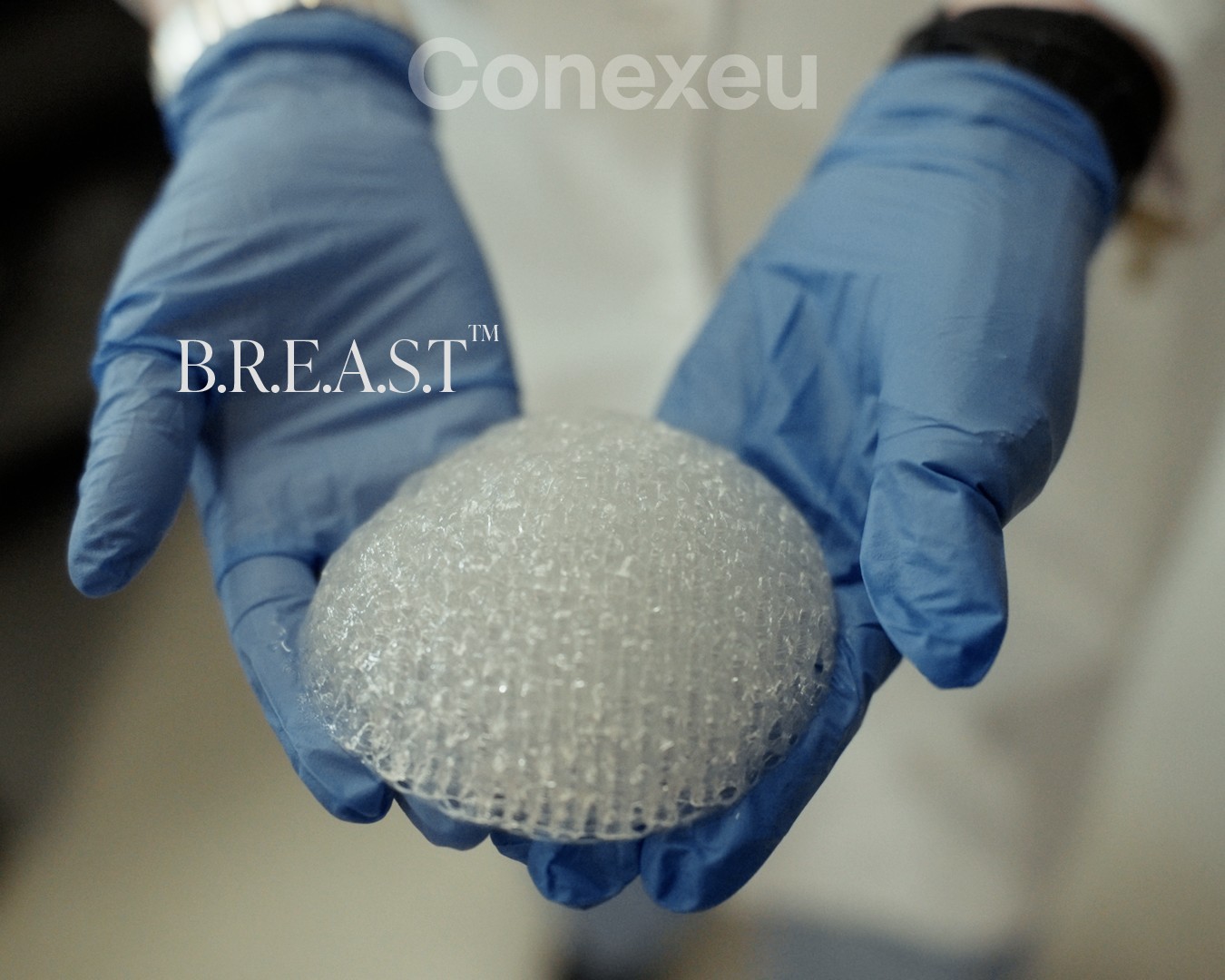
Conexeu Sciences unveils B.R.E.A.S.T. 3D-bioprinted resorbable matrix for breast reconstruction

Application
Originally reported by 3D ADEPT
Conexeu Sciences, a biotechnology company, has announced the development of B.R.E.A.S.T. (BIO-REGENERATIVE ERGONOMICALLY ARCHITECTED SMART TISSUE), a 3D-bioprinted breast matrix designed to guide the patient's own body into rebuilding tissue. The system is built on Conexeu's proprietary CXU platform, an extracellular matrix (ECM)-based biofabrication technology. Unlike conventional silicone implants or synthetic scaffolds, B.R.E.A.S.T. is designed to be resorbable: the scaffold degrades progressively as the patient's own cells migrate, vascularize, and form new tissue. Patient-specific CT scans would be used to customize each matrix to individual anatomy, with the company stating the ambition to shift the paradigm from substitution to regeneration.
This announcement lands in a bioprinting segment that has long promised clinical translation but delivered few approved products. Conexeu's approach directly targets the $1.5 billion global breast reconstruction market, where over 100,000 procedures are performed annually in the US alone. The resorbable ECM-based strategy differentiates from competitors like 3D Systems' regenerative medicine efforts or CollPlant's rhCollagen-based bioinks, which focus on scaffold materials rather than full anatomical matrices. The CXU platform's ability to integrate patient-specific geometry with a degradable ECM scaffold addresses a critical gap: current synthetic scaffolds often fail to achieve complete vascularization, leading to necrosis or poor tissue integration. Conexeu's value-chain position is vertically integrated, combining bioink development, bioprinting hardware, and clinical workflow software, which could accelerate regulatory pathways but also increases capital requirements for clinical trials.
For Conexeu, the immediate challenge is generating clinical evidence. The company must demonstrate that B.R.E.A.S.T. achieves consistent vascularization and tissue remodeling in human trials, a hurdle that has stalled many bioprinting candidates. The FDA's 510(k) pathway for resorbable implants is well-established, but the novelty of the ECM-based matrix may require a de novo classification, adding time and cost. Practically, the company should prioritize a first-in-human study with a small cohort to establish safety and proof-of-concept before scaling to broader trials. The technology is promising, but the gap between a preclinical announcement and a reimbursed clinical product remains wide.
Topics