Consumer CNC company Makera (造物时代) raises hundreds of millions RMB in Series A funding
Originally reported by finance.sina.cn
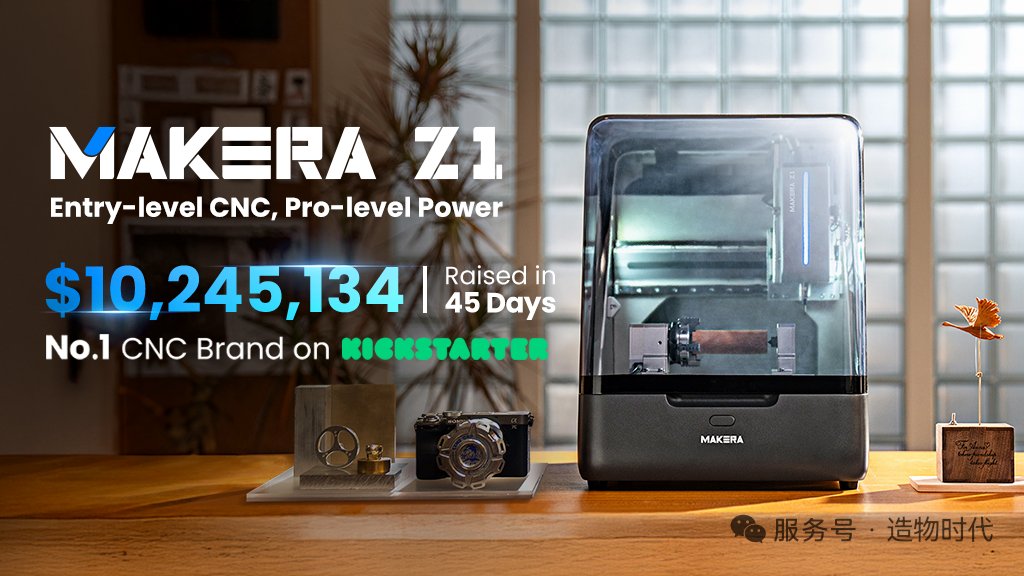
Makera (造物时代), a Chinese company focused on desktop CNC machines, has closed a Series A funding round worth hundreds of millions of RMB (approximately $14-28M USD). The round was co-led by Huaying Capital and the Beijing Artificial Intelligence Industry Investment Fund, with participation from Yuanhe Puhua, Zhongke Chuangxing, Qingke Venture Capital, and follow-on investment from existing investor Qiming Venture Partners. This is the largest single financing round in the consumer CNC category to date. The company’s flagship product, the Z1, raised $10.25M on Kickstarter in Q4 2025 from nearly 8,000 backers, setting a global crowdfunding record for the CNC segment.
This funding is significant for the broader digital fabrication ecosystem, which includes both additive and subtractive manufacturing. Makera is pursuing the same “desktop factory” vision that has driven companies like Glowforge (laser cutting) and Bambu Lab (FDM/FFF 3D printing) - taking industrial-grade capability and packaging it for prosumers, designers, and makers. While 3D printing has dominated the desktop manufacturing narrative, CNC subtractive manufacturing addresses a complementary gap: high-precision metal and multi-material machining that additive processes cannot yet match in surface finish or material properties. Makera’s integrated CAM software and toolpath algorithms lower the engineering barrier, directly competing with traditional desktop CNC players like Carbide 3D, Bantam Tools, and Snapmaker’s hybrid machines. The company’s focus on a content community for sharing parameters and designs mirrors the ecosystem-building strategy that has accelerated adoption in polymer AM.
From an expert standpoint, the key execution challenge for Makera is transitioning from crowdfunding hype to reliable, repeatable production and global service infrastructure. The Z1’s crowdfunding success proves demand, but desktop CNC buyers are notoriously sensitive to machine rigidity, dust management, and software stability - issues that have plagued earlier entrants. Makera’s deep integration of robotics-derived control systems and its proprietary CAM stack are credible differentiators, but the company must now deliver on pre-orders and build a service network that matches the expectations set by Bambu Lab in 3D printing. If it succeeds, Makera will have validated a parallel “consumer subtractive” market that has long been overshadowed by additive manufacturing.
This article is an AI-assisted rewrite of the linked source report. Facts originate from the source; phrasing is AMPulse's. Use Read Original below to verify, or Report an issue if something is wrong.