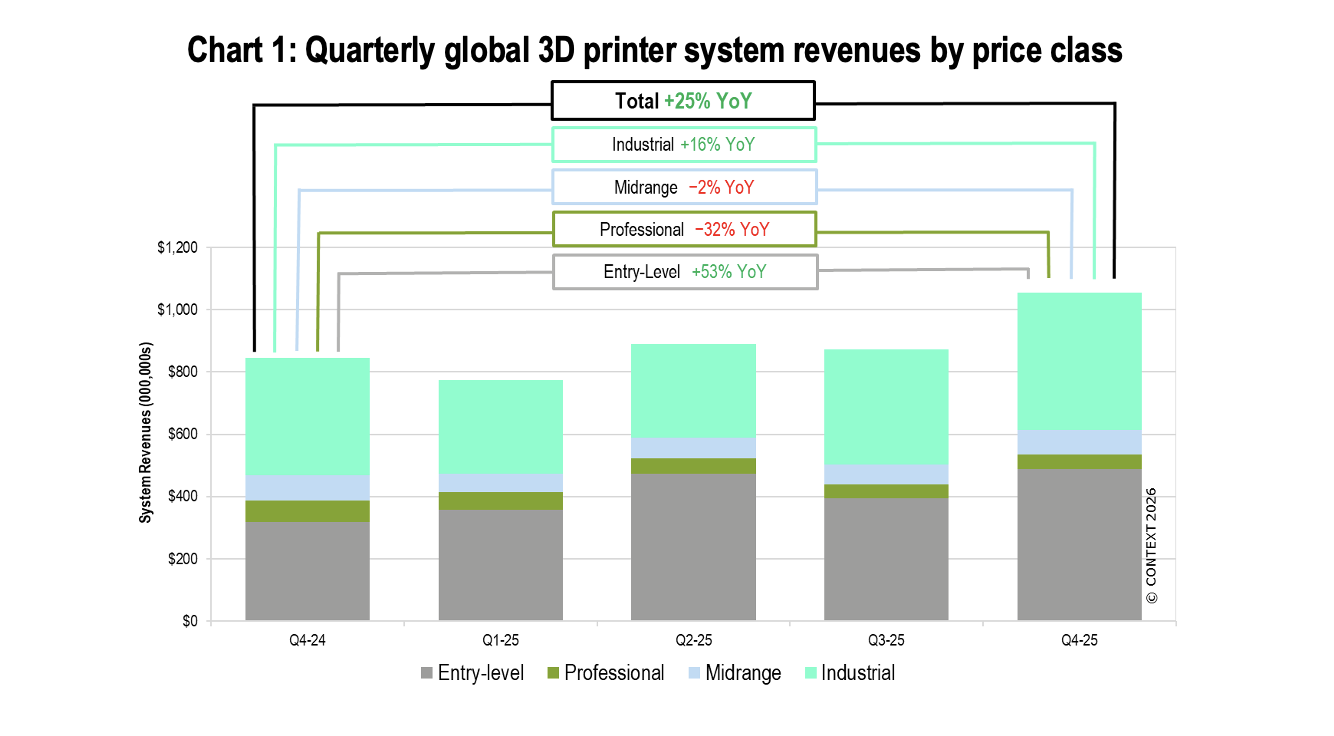
CONTEXT data shows AM hardware market polarizing with 47% entry-level growth and 12% industrial rebound in Q4 2025
Originally reported by 3D Printing Industry
Market intelligence firm CONTEXT has published its Q4 2025 analysis of global 3D printer hardware shipments, revealing a market reorganizing around two distinct poles. Entry-level systems priced below $2,500 saw shipments rise 47% year-on-year in Q4, driving a 53% revenue increase, with Chinese vendors accounting for over 90% of global shipments in this segment. At the opposite end, industrial systems above $100,000 posted a 12% unit increase and 16% revenue growth, reversing four consecutive years of full-year unit declines, while midrange and professional systems continued their contraction with quarterly declines of 6% and 12% respectively.
This data crystallizes a structural shift that has been building for multiple quarters: the additive manufacturing hardware market is no longer a single, uniformly growing entity. The explosive growth at the entry level, overwhelmingly driven by Chinese manufacturers like Bambu Lab, Creality, Elegoo, and Anycubic, represents the consumer-electronics titanium pull-through pattern in its purest form-relentless innovation and cost compression creating a new performance-per-dollar benchmark that reshapes demand across adjacent segments. Meanwhile, the industrial rebound, while less dramatic, signals a return to disciplined growth within the aerospace qualification grind and defense verticals, where programmatic wins and strategic focus have replaced the hype-driven expansion of previous cycles.
The practical implication is that hardware vendors must now choose their lane with precision. Companies targeting the middle market face existential pressure from both sides: from above by industrial systems delivering certified production value, and from below by consumer-grade machines offering industrial-grade features at a fraction of the cost. For buyers, this polarization creates clearer decision frameworks-entry-level for prototyping and education, industrial for qualified production-but erodes the value proposition of systems designed for the shrinking middle ground where capability and cost once met.
This article is an AI-assisted rewrite of the linked source report. Facts originate from the source; phrasing is AMPulse's. Use Read Original below to verify, or Report an issue if something is wrong.
Topics