Creality patents multi-directional buffer foot design for vibration reduction on desktop FFF printers

Hardware
Originally reported by Fabbaloo
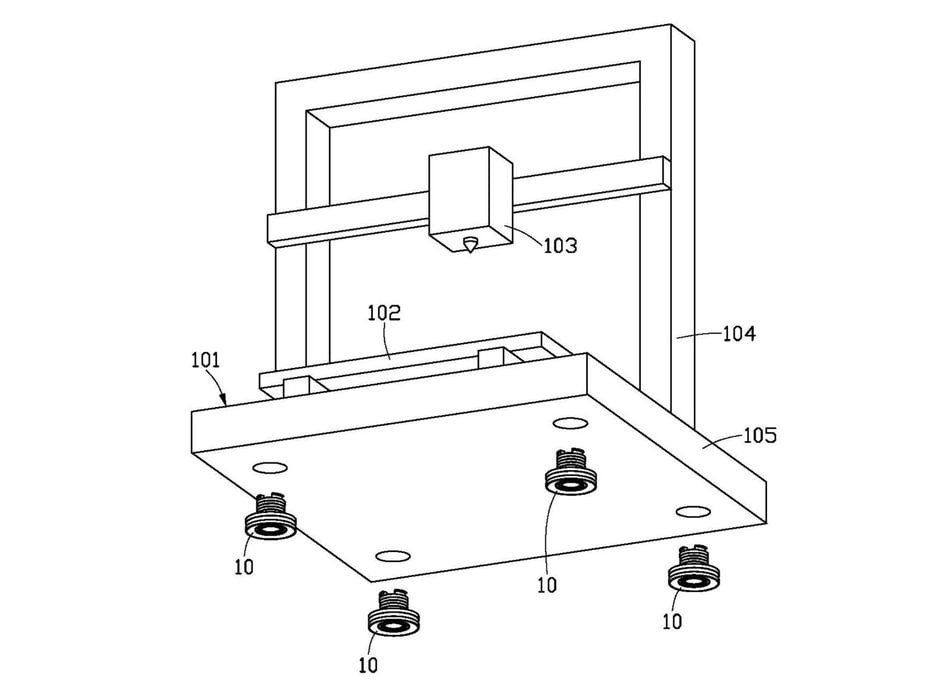
Creality has been granted Chinese utility model patent CN224323577U for a 3D printer foot designed as a multi-directional buffer element. Assigned to Shenzhen Creality Ecosystem Innovation Technology Co., Ltd., the patent describes a foot with two primary structures: a vertical compression section featuring sawtooth or wave-shaped hollow features that deform along the Z-axis, and a lateral compliance section with two protruding plate-like segments separated vertically and joined by a narrower connecting section, allowing the upper protrusion to swing relative to the lower one. The foot also includes a suction element with an arched bottom surface that deforms under printer weight to create a vacuum cavity, plus ring-shaped protrusions on the bottom to improve grip on imperfect surfaces. The patent suggests materials such as silicone or rubber, and one-piece injection molding as a possible manufacturing method.
This patent addresses a real but often overlooked mechanical detail in the desktop FFF market, where printers now routinely run high accelerations, fast travel moves, and input-shaping algorithms. As the consumer/prosumer polymer extrusion segment has shifted from basic capability to speed and print quality, vibration artifacts and noise have become differentiating factors. Creality is attempting to engineer a solution that provides compliance in multiple axes rather than relying on users to improvise with paving stones or foam pads. The desktop FFF market has largely commoditized motion systems, hotends, and extruders; hardware refinements like this foot design represent the kind of incremental mechanical improvement that can affect perceived quality and out-of-box user experience, particularly on fast CoreXY or bed-slinger machines.
This is a minor patent filing, not a product launch. The patent provides no performance data comparing the buffer foot to a standard rubber pad, and the foot design introduces its own mechanical complexity - the foot becomes part of the printer's resonant system, which input shaping must account for. For Creality, the practical value depends on whether they integrate this into a shipping product and whether the suction and multi-axis compliance meaningfully reduce real-world vibration artifacts without introducing new problems like machine walk or inconsistent layer adhesion. Users should treat this as an engineering exploration, not a near-term feature upgrade.
Topics