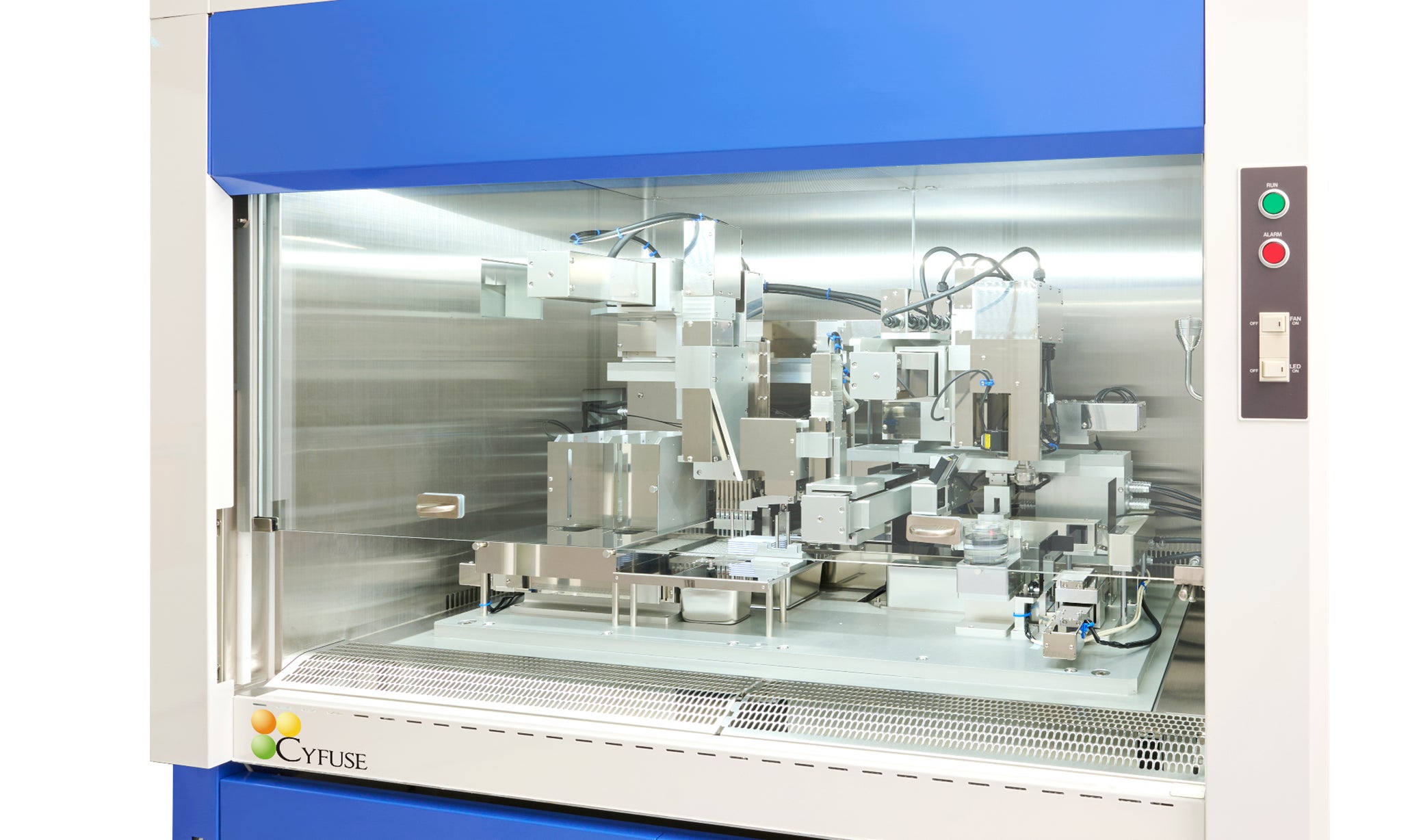
Cyfuse and NSK announce the development of a new bio-3D printer designed for the commercial production of regenerative medicine and 3D cell products.

Hardware
Originally reported by PR TIMES
Cyfuse and NSK announce the development of a new bio-3D printer designed for the commercial production of regenerative medicine and 3D cell products. This device integrates Cyfuse's proprietary bio-3D printing technology with NSK's industrial motion control systems, specifically incorporating low-dust, decontamination-ready actuators to meet cleanroom requirements. The collaboration, which began in 2022, has successfully transitioned from initial R&D to a functional platform capable of scaling up tissue production while automating the dispensing and layering processes within a single safety cabinet. Cyfuse CEO Shizuka Akieda and NSK leadership have focused this development on overcoming the manual bottlenecks currently hindering the mass production of clinical-grade cell-based therapies.
This development addresses the critical transition from laboratory-scale prototyping to industrial-scale manufacturing in the regenerative medicine sector. While many bio-printing firms focus on research-grade equipment, Cyfuse is positioning itself as a provider of end-to-end production infrastructure, competing with firms like Organovo or BICO in the broader bioprinting landscape. By leveraging NSK's expertise in high-precision bearing and actuator technology, Cyfuse is attempting to solve the reliability and repeatability issues that often plague automated biological manufacturing. The ability to standardize the production of 3D cell products is a prerequisite for regulatory approval and commercial viability in the global cell therapy market, which is currently experiencing significant growth as clinical pipelines move toward late-stage trials.
For the industry, this partnership demonstrates the necessity of integrating industrial-grade mechanical engineering into biological manufacturing workflows to achieve consistent output. The success of this platform depends on Cyfuse's ability to demonstrate that the increased build volume and automated process control can maintain cell viability and structural integrity at scale. Potential adopters should evaluate the system's throughput capabilities and compliance with GMP standards as the company moves toward commercial deployment in the healthcare and cosmetic sectors. The upcoming demonstration at the 25th Annual Meeting of the Japanese Society for Regenerative Medicine will be the first opportunity to assess the hardware's operational readiness.
This article is an AI-assisted rewrite of the linked source report. Facts originate from the source; phrasing is AMPulse's. Use Read Original below to verify, or Report an issue if something is wrong.
Topics