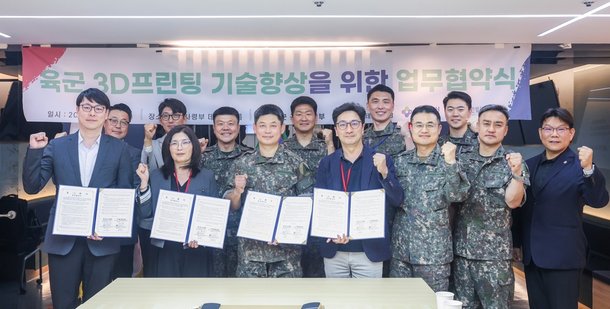
Daejeon Technopark and South Korean Army sign MOU to advance military 3D printing technology
Originally reported by nate.com
Daejeon Technopark (Daejeon TP) signed a memorandum of understanding on May 6, 2026, with the South Korean Army's Ground Operations Command, the Korea Institute of Industrial Technology (KITECH), and Chungnam National University to advance military 3D printing technology. The agreement, announced on May 7, focuses on standardizing additive manufacturing processes for defense applications and building a rapid-response supply system for military parts. Key areas include developing 3D printing standards for parts such as vehicle and aircraft components, establishing a joint R&D program for operational equipment, and creating a policy roadmap for military supply chain modernization. Daejeon TP President Park Youn-bae stated the goal is to "accelerate the transition of 3D printing technology from the lab to the battlefield."
This partnership reflects the accelerating defense-driven adoption of additive manufacturing globally, particularly in Asia, where military modernization programs are creating structured demand for AM. The MOU aligns with the broader pattern of "Chinese localization arc" (P2) but with a distinctly South Korean twist: rather than matching Western specs, the consortium aims to build a domestic qualification and supply chain framework from scratch. The involvement of KITECH, a national research institute, and Chungnam National University provides the R&D backbone, while the Army's Ground Operations Command offers the operational pull-through. This is a classic "aerospace qualification grind" (P4) pattern applied to military ground systems, where the 10–15 year journey from concept to embedded production is compressed by political will and national security urgency.
For the South Korean defense industry, this MOU is a concrete step toward reducing reliance on foreign spare parts and enabling on-demand production of legacy and new components. The practical challenge now is execution: the consortium must move from MOU to actual qualification standards, material certifications, and field-testing protocols. If successful, this could create a template for other Asian militaries seeking AM-based supply chain resilience. The immediate next step is the joint R&D program, which will determine whether the partnership delivers operational parts or remains a policy document.
This article is an AI-assisted rewrite of the linked source report. Facts originate from the source; phrasing is AMPulse's. Use Read Original below to verify, or Report an issue if something is wrong.
Topics