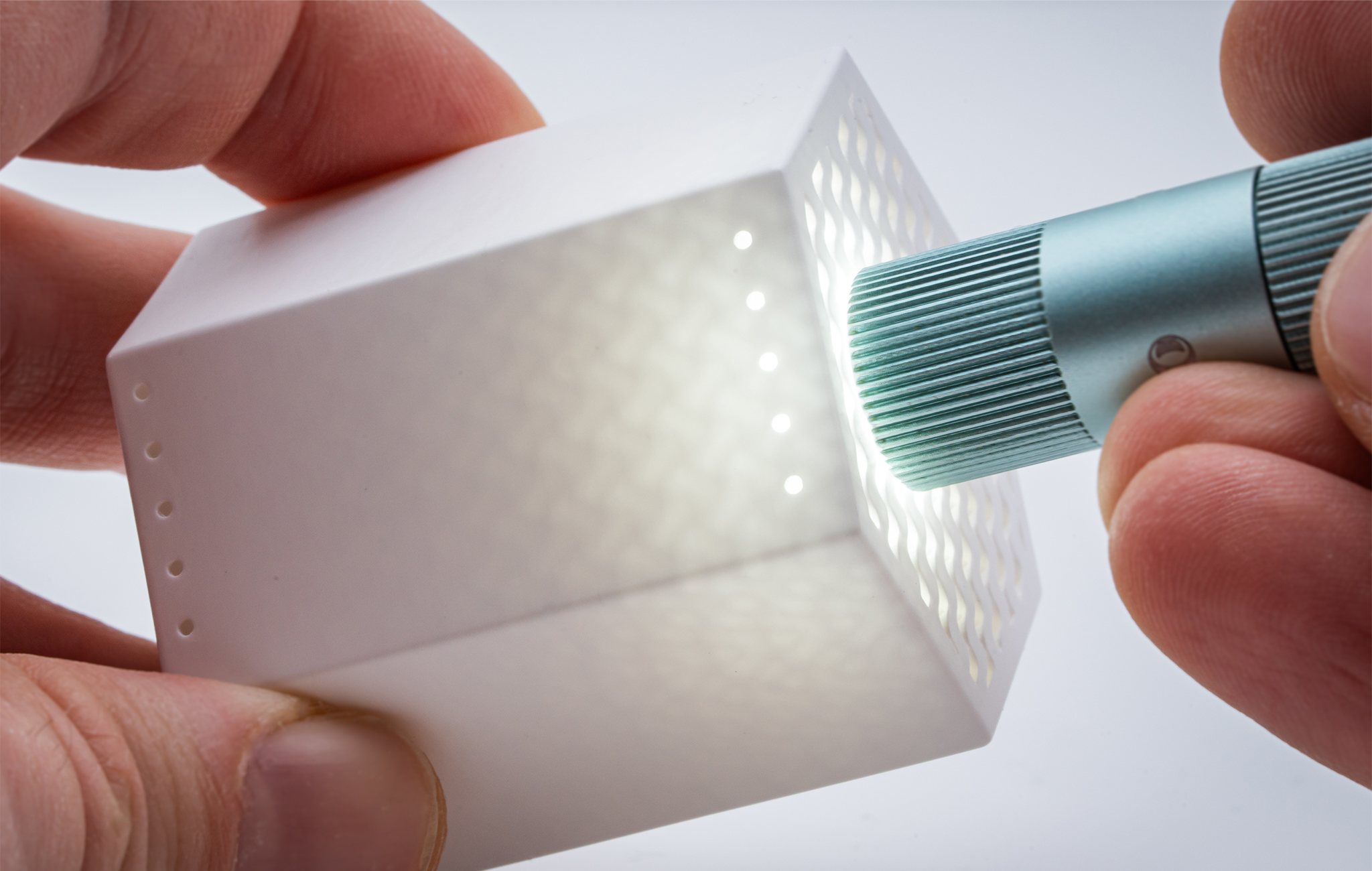
DTU achieves 5x power-to-weight gain in solid oxide fuel cells using Lithoz ceramic 3D printing

Hardware
Originally reported by 3D Printing Industry
Researchers at the Technical University of Denmark (DTU) have fabricated monolithic solid oxide fuel cells (SOFCs) with gyroid architectures using a Lithoz CeraFab printer, achieving a power-to-weight ratio of approximately 1 W g⁻¹ - roughly five times higher than the 0.2 W g⁻¹ typical of conventional planar SOFC designs. Led by Professor Vincenzo Esposito at DTU Energy, the project used 8 mol% yttria-stabilized zirconia (8YSZ), a standard electrolyte material, to print thin-walled gyroid geometries that eliminate interconnects and sealants. The team, including mechanical behavior expertise from DTU Construct, validated the structural stability of the architecture under thermal and operational conditions. Johannes Homa, CEO of Lithoz, noted the design reduces dependence on the interconnect and sealing stacks inherent to flat-cell designs.
This result matters because it demonstrates that ceramic AM can unlock performance in energy devices that conventional manufacturing cannot reach. The gyroid architecture - a triply periodic minimal surface (TPMS) geometry - allows monolithic construction with thin internal walls and a sealed gastight shell, directly addressing the weight and thermal mismatch penalties of stacked planar SOFCs. For Lithoz, the project validates its LCM (Lithography-based Ceramic Manufacturing) technology in a high-value energy application beyond dental and medical implants, where the company has its strongest commercial base. The achievement also fits the broader pattern of AM enabling lightweight, architected structures for transportation - here, hydrogen-powered marine, land, and aerial vehicles - where every gram of fuel cell mass directly impacts range and efficiency. Conventional SOFC manufacturing cannot produce such geometries at all, giving Lithoz a clear differentiation against other ceramic AM processes like binder jetting or material extrusion.
For Lithoz, the practical next step is translating this proof-of-concept into industrially repeatable production - scaling from lab-scale CeraFab units to a process that can deliver consistent gastight performance across hundreds of cells. The company must also demonstrate that the 8YSZ gyroid architecture survives thermal cycling and long-duration operation without microcracking, which is the primary failure mode for thin-walled ceramics in SOFC environments. DTU's plan to industrialize the design means Lithoz needs to show its LCM platform can maintain the sub-100-micron wall thickness and dimensional accuracy required at higher throughput, or the technology remains a laboratory curiosity rather than a transportation powertrain solution.
This article is an AI-assisted rewrite of the linked source report. Facts originate from the source; phrasing is AMPulse's. Use Read Original below to verify, or Report an issue if something is wrong.