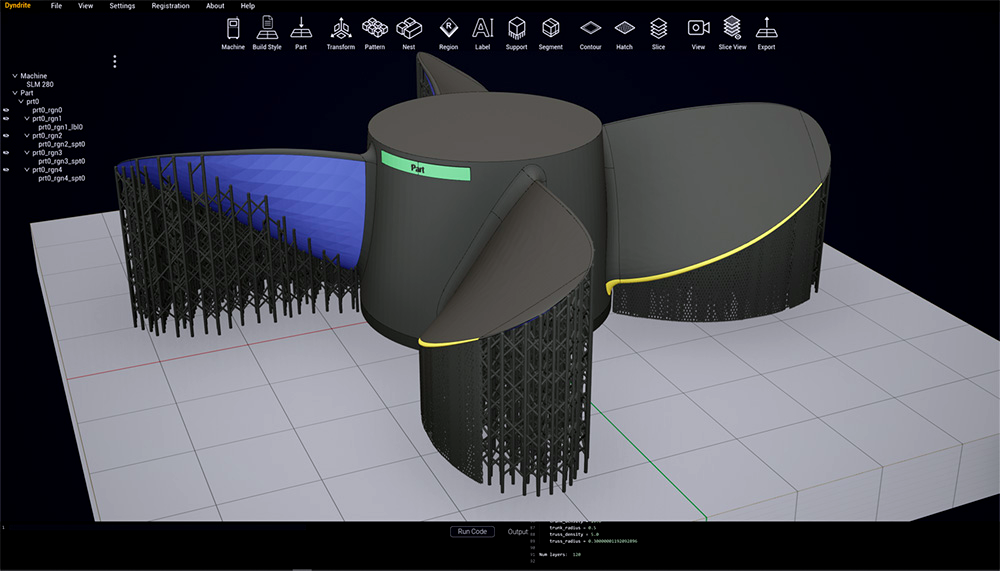
Dyndrite to lead America Makes' $2M AIM-4AM project on AI for material allowables in additive manufacturing

Software
Originally reported by TCT Magazine
Dyndrite has been selected by America Makes and the National Center for Defense Manufacturing and Machining (NCDMM) to lead the Artificial Intelligence for Material Allowables in Additive Manufacturing (AIM-4AM) project, a $2 million initiative funded by the Office of the Under Secretary of Defense Manufacturing Technology Office (OSD ManTech). The software company will develop an AI-driven framework to identify and quantify risks within the existing material allowables approach for Laser Powder Bed Fusion (LPBF). Dyndrite leads a team that includes Mimo Technik, which will execute controlled LPBF builds and testing coordination, and RTX, serving as the technology transition partner to ensure aerospace and defense relevance. The project will demonstrate the framework using 17-4PH stainless steel in the H1025 condition, aiming to reduce the time, cost, and testing burden associated with traditional AM qualification and certification workflows while maintaining rigorous statistical and engineering confidence.
This project directly addresses the central bottleneck in scaling metal AM for regulated industries: the qualification grind. Aerospace and defense adoption has been constrained by the need for extensive C/D basis physical testing, driven by the uncertainty inherent in machine-to-machine variability and process drift. By applying machine learning to quantify that uncertainty using process control data, data pedigree, and statistical confidence, Dyndrite is attempting to move the industry from brute-force physical testing toward statistically informed reduced-testing protocols. This aligns with a broader Department of Defense push to accelerate AM industrialization, and it updates the long-running debate about whether AI can meaningfully compress qualification timelines without sacrificing engineering rigor. The involvement of RTX as a transition partner signals that the output is intended for real program application, not just academic validation.
For Dyndrite, the practical challenge is execution: the framework must produce allowables that certification authorities and prime contractors trust, which requires not only sound ML methodology but also traceable manufacturing data and controlled build conditions. The project's success will be measured by whether the AI predictions hold up against experimental tensile and fatigue data, and whether the reduced-testing protocols gain acceptance from organizations like the FAA or DoD. If the framework proves out, it could become a reference architecture for how AI is integrated into AM qualification workflows, but the burden of proof remains high.
This article is an AI-assisted rewrite of the linked source report. Facts originate from the source; phrasing is AMPulse's. Use Read Original below to verify, or Report an issue if something is wrong.