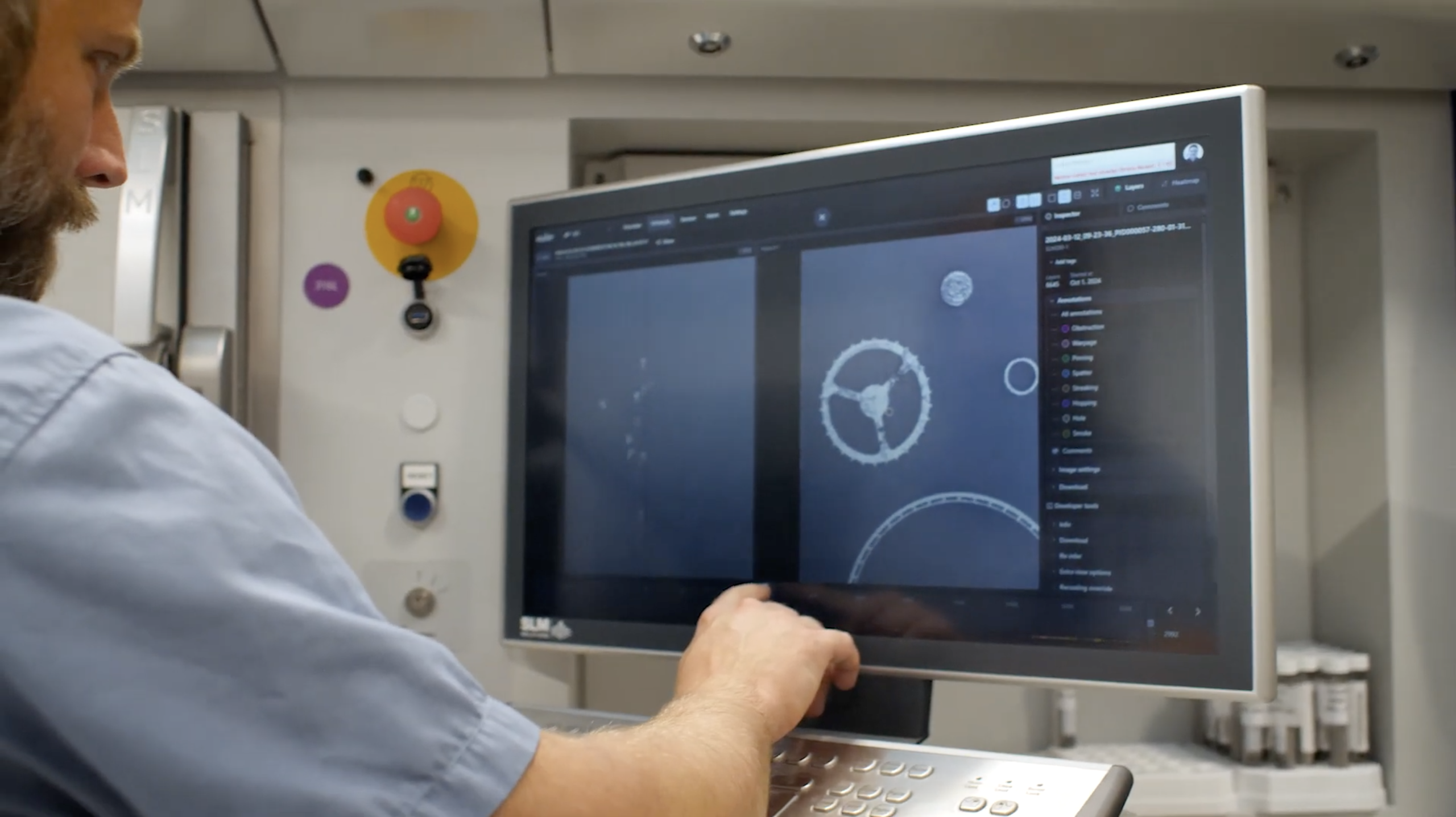
Euler launches free real-time build visibility tool for metal AM operators

Software
Originally reported by 3D Printing Industry
Icelandic software startup Euler has released Euler Viewer, a browser-based tool that gives metal LPBF operators live visibility into their builds at no cost, with no hardware required. The platform streams powder bed images directly to a browser as a build progresses, built on SOC 2 Type II security controls and requiring no connection to the printer's control PC. Operators can move through a build layer by layer, share access with colleagues via a link, and for printers that cannot be connected directly, upload build data manually. The company closed a €2 million seed round in November 2025 co-led by Frumtak Ventures and Kvanted, and holds several patent applications in real-time monitoring and failure prediction for additive manufacturing.
This move targets a persistent gap in the metal AM workflow: build monitoring has historically been locked behind expensive, hardware-dependent systems sold as premium add-ons, or tied to proprietary machine ecosystems like Velo3D's Assure software. Phase3D's Fringe Research, developed with the US Air Force and NASA, requires structured light hardware mounted to the printer before any monitoring takes place. Euler's software-only approach, requiring nothing beyond a browser, sets a different baseline for what basic process visibility should cost. For a metal AM market where the industrial segment (AMPOWER scope) reached €11.33B in 2025, the ability to decouple monitoring from hardware spend could accelerate adoption among mid-tier service bureaus and R&D labs that cannot justify the capital outlay for dedicated monitoring systems.
Euler's strategy is straightforward: get operators onto the free platform first, then sell them the paid tier that adds automated defect detection, predictive failure alerts, and statistical process control. The company's immediate execution challenge is proving that its defect detection algorithms generalize across the wide variety of LPBF systems on the market, not just the handful it has tested. For operators evaluating the tool, the practical test is whether the free tier's basic visibility meaningfully reduces the time spent walking to the printer or checking remote desktop feeds - if it does, the upgrade conversation writes itself.
Topics