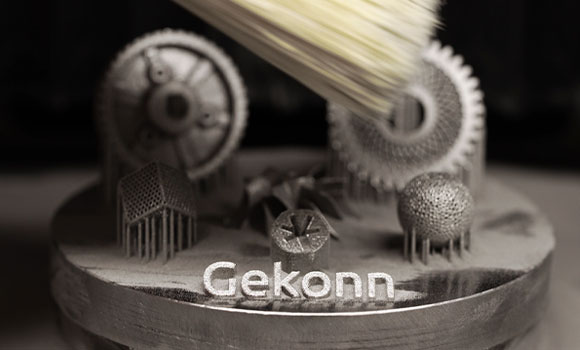
Gekonn targets process repeatability with three-machine LPBF portfolio for industrial production

Hardware
Originally reported by Metal AM
Gekonn, the metal additive manufacturing machine brand developed by Slovenia-based Sipra, has positioned its three-machine Laser Beam Powder Bed Fusion (PBF-LB) portfolio around the transition from prototype success to repeatable industrial production. The lineup includes the LMP 100v3 for R&D and low-volume work, the LMP 200 for small-batch manufacturing, and the LMP 300 for serial production of larger components. Rather than competing on raw laser power or build speed alone, Gekonn emphasizes closed-loop powder handling, controlled processing environments, and in-process monitoring to manage porosity, residual stress, oxidation, and thermal gradients - particularly for reactive materials such as titanium and aluminium alloys. The company also highlights open architecture for parameter access, including scan strategy management, to support material qualification and application development.
This positioning addresses a persistent gap in metal AM: the difference between making one good part and making ten thousand identical ones. While many machine vendors focus on maximum build volume or laser count, Gekonn is betting that industrial buyers - especially those in aerospace, medical, and tooling - will pay for deterministic process control and engineering support over raw hardware specs. The company’s emphasis on open parameter access and scan strategy tuning reflects a recognition that closed, black-box systems can slow qualification, particularly for regulated verticals. Gekonn’s approach mirrors the broader industry shift from machine-centric marketing to service-based adoption, where repeatability and support infrastructure matter more than peak throughput. The company’s home base in Slovenia also places it outside the direct crossfire of US-China trade tensions, potentially offering European and Western buyers a neutral sourcing option.
For industrial users evaluating metal AM for production, Gekonn’s value proposition hinges on execution: the company must demonstrate that its process monitoring and powder handling systems actually reduce build-to-build variation in real factory environments, not just in lab demos. The open architecture is a practical advantage for materials engineers who need to tune parameters for specific alloys or geometries, but it also places more responsibility on the user. Gekonn’s near-term credibility will depend on published qualification data and referenceable customer installations, particularly in aerospace or medical where repeatability is non-negotiable.
Topics