Graphy, a South Korean 3D printing materials developer, has successfully engineered a soft denture liner material, designated as GR-C, in collaboration with researchers from Dankoo...

Materials
Originally reported by edaily.co.kr
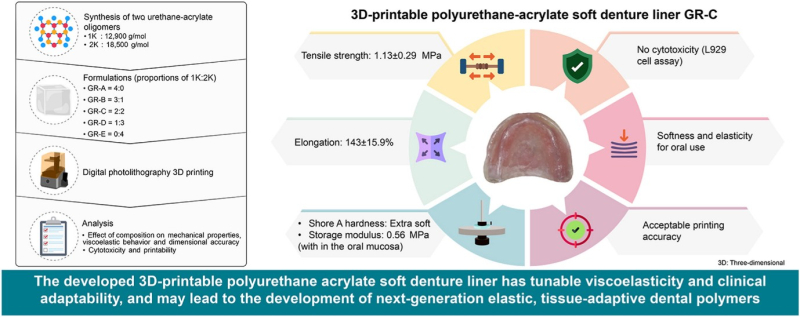
Graphy, a South Korean 3D printing materials developer, has successfully engineered a soft denture liner material, designated as GR-C, in collaboration with researchers from Dankook University and Yonsei University. The findings, published in the Journal of the Mechanical Behavior of Biomedical Materials (JMBBM), detail a polyurethane acrylate (PUA) based composition that achieves mechanical properties comparable to traditional silicone-based liners. The material exhibits a storage modulus within the 0.4 to 4.4 MPa range, matching human oral mucosa elasticity, and maintains stability for 30 days while achieving a printing precision of 0.619 mm RMS deviation.
The development addresses a significant limitation in dental additive manufacturing, where manual fabrication of soft liners often leads to porosity, bacterial colonization, and plasticizer leaching. By transitioning to a digital workflow, Graphy aims to replace conventional labor-intensive casting methods with a more consistent, biocompatible, and automated process. This advancement positions the company to capture a larger share of the dental prosthetics market, specifically in the high-growth segment of patient-specific, long-term removable appliances.
Graphy must now focus on validating long-term adhesion to various denture base resins and completing rigorous clinical stability testing to ensure performance in complex oral environments. For dental laboratories and clinicians, this material offers a path toward fully digital, chairside-ready denture production. Success will depend on the material's ability to maintain its mechanical integrity under cyclic loading and moisture exposure over extended periods of use.
This article is an AI-assisted rewrite of the linked source report. Facts originate from the source; phrasing is AMPulse's. Use Read Original below to verify, or Report an issue if something is wrong.
Topics