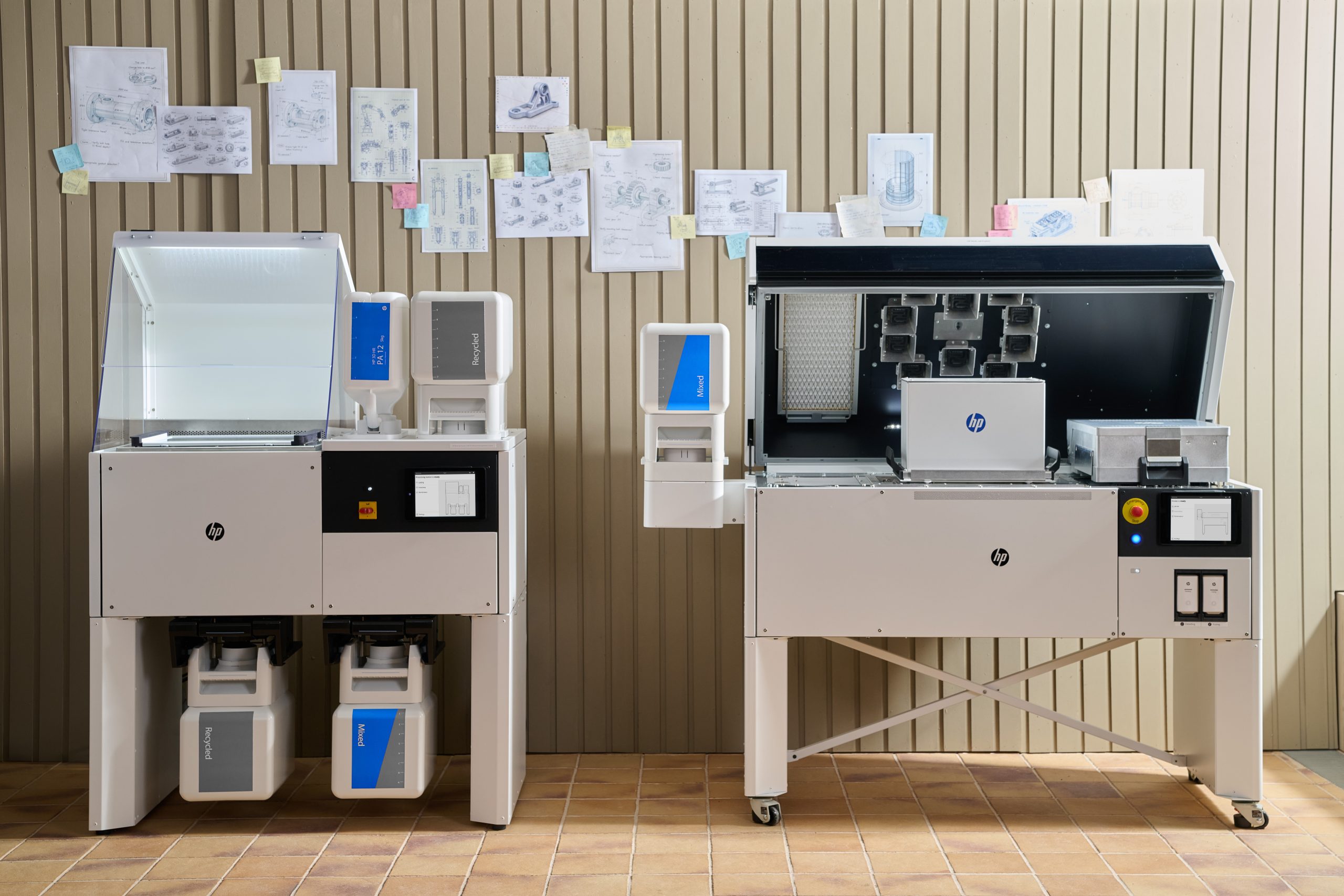
HP unveils smallest Multi Jet Fusion 3D printer MJF 1200 at RAPID + TCT 2026

Hardware
Originally reported by 3D Printing Industry
HP used RAPID + TCT 2026 to announce the MJF 1200, its smallest Multi Jet Fusion system to date, featuring a 12-liter build volume and full availability planned for early 2027. Every unit ships bundled with Magics Print for HP, a build-preparation software from Materialise integrated into the CO-AM ecosystem. HP also introduced a High Productivity print mode for the Jet Fusion 5600 series, boosting output by 20%, and added HP 3D High Reusability PA 12 Glass Beads material. A new MJF Dual Tone capability, enabling white and grey part markings and QR codes, will arrive on the 5600 in late 2026. On the metal side, HP qualified three new materials for the Metal Jet S100 platform - copper, M247LC nickel-based superalloy, and tungsten carbide-cobalt - and announced a collaboration with Volkmann GmbH for the vPort semi-automated depowdering system.
This launch represents HP's effort to bridge the gap between centralized production and engineering-desktop access, a move that directly challenges the polymer desktop-to-industrial continuum occupied by Stratasys' H350 and SLS systems from EOS and Formlabs. The 12-liter build volume is notably smaller than the 5600 series' 48-liter capacity, targeting design studios, clinical settings, and small-batch production where floor space and throughput requirements are lower. The bundled Magics Print software reduces workflow friction, a critical factor for users migrating from prototyping to production. The metal-side material qualifications - particularly copper for thermal management and M247LC for aerospace - extend HP's reach into electrification and high-temperature applications, segments where binder jetting competes with LPBF and metal injection molding. The vPort depowdering system addresses a persistent pain point in metal binder jetting: safe, contained powder handling for facilities that cannot justify fully automated systems.
For HP, the MJF 1200 is a tactical expansion of its addressable market rather than a technology inflection. The real execution test lies in the 2027 availability timeline and whether the compact format can maintain the part quality and material consistency that the 5600 series has established in production environments. Users evaluating the system should compare its per-part cost and throughput against service bureau quotes for similar volumes, as the value proposition depends on utilization rates rather than hardware price alone. The metal material qualifications and vPort partnership are incremental but practical steps that strengthen the Metal Jet ecosystem for customers already committed to binder jetting workflows.
Topics