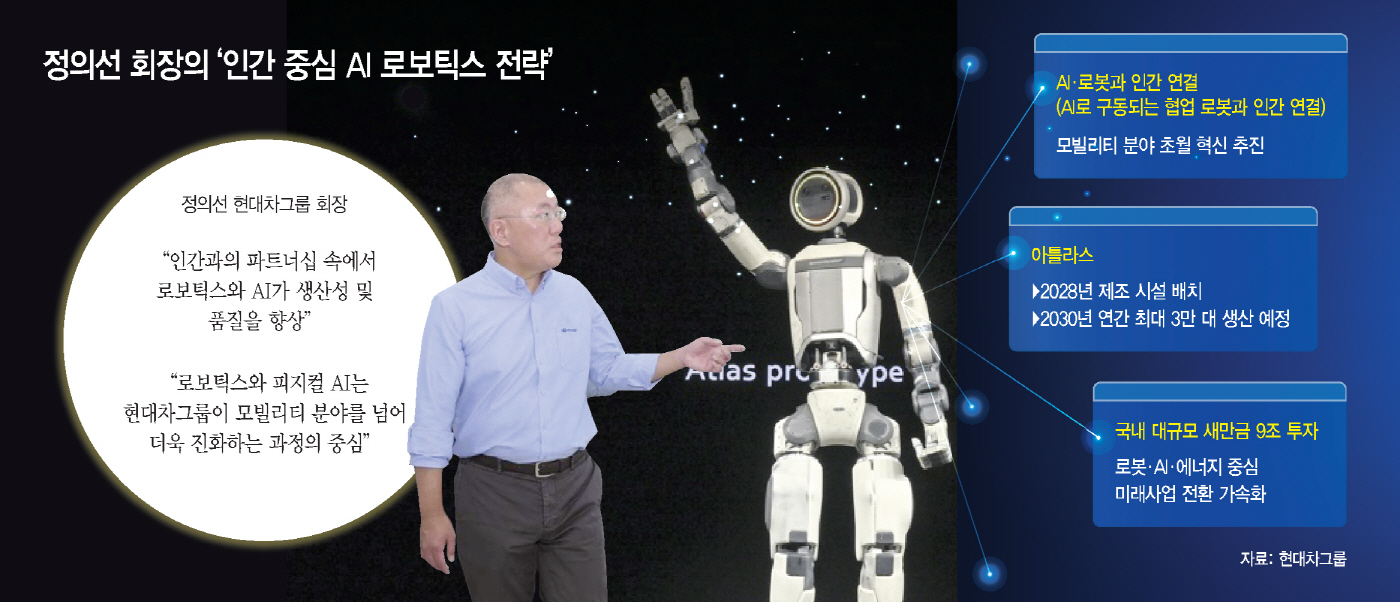
Hyundai Motor Group has announced a strategic initiative to integrate Boston Dynamics' Atlas humanoid robots into its automotive manufacturing facilities, targeting an annual produ...
Originally reported by asiatoday.co.kr
Hyundai Motor Group has announced a strategic initiative to integrate Boston Dynamics' Atlas humanoid robots into its automotive manufacturing facilities, targeting an annual production capacity of 30,000 units by 2030. CEO Euisun Chung confirmed that the deployment of these robots will commence in manufacturing plants by 2028, supported by a 9 trillion KRW investment in a new industrial cluster in Saemangeum, South Korea. This facility will integrate AI-driven robotics, hydrogen electrolysis plants, and AI data centers to facilitate the transition toward human-robot collaborative production systems. The project aims to leverage physical AI to automate high-precision and hazardous tasks, while human operators transition to roles focused on robot management and system optimization.
This move represents a significant scaling of humanoid robotics within the automotive sector, moving beyond traditional industrial robotic arms toward mobile, bipedal platforms capable of navigating complex assembly environments. While traditional automotive manufacturing relies on fixed-position automation, the introduction of Atlas suggests a shift toward flexible, reconfigurable production lines that can adapt to high-mix, low-volume vehicle architectures. Hyundai's investment in the Saemangeum cluster positions the company to vertically integrate its robotics hardware with the energy infrastructure required to sustain large-scale AI compute and hydrogen-based manufacturing power. The primary challenge remains the integration of these systems into existing unionized labor environments, where human-robot interaction protocols must be strictly defined to ensure safety and operational continuity.
For the manufacturing sector, the success of this deployment depends on the reliability of the Atlas platform in performing repetitive, high-precision tasks over extended shifts without frequent maintenance downtime. Integration of physical AI requires robust sensor fusion and real-time data processing to ensure that robots can operate safely alongside human workers in dynamic environments. Stakeholders should focus on the specific payload capacities and cycle times achieved during the initial 2028 pilot phase to determine the viability of replacing or augmenting traditional fixed-automation cells in automotive assembly.
This article is an AI-assisted rewrite of the linked source report. Facts originate from the source; phrasing is AMPulse's. Use Read Original below to verify, or Report an issue if something is wrong.
Topics