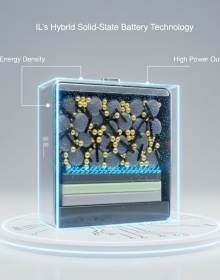
IL has filed a patent for a hybrid manufacturing technology that integrates thin-film and thick-film structures for small-scale solid-state batteries.
Originally reported by newspim.com
IL has filed a patent for a hybrid manufacturing technology that integrates thin-film and thick-film structures for small-scale solid-state batteries. The process utilizes 3D printing to combine the high-power density of thin-film cells with the high-capacity storage of thick-film electrodes into a single, unified architecture. This development aims to overcome the traditional trade-off between power output and energy capacity in micro-battery designs, specifically targeting power supply requirements for humanoid robotics and compact mobile platforms. The company plans to integrate this proprietary manufacturing method with its existing 3D printing-based battery production capabilities to optimize energy density and structural efficiency for specialized hardware applications.
This development positions IL within the intersection of additive manufacturing and advanced energy storage, a critical niche for autonomous robotics where space constraints limit standard battery form factors. By leveraging 3D printing to manage electrode thickness and material deposition, the company is attempting to move beyond the limitations of conventional roll-to-roll manufacturing for small-format energy systems. The ability to customize battery geometry to fit complex robotic chassis represents a functional advantage over off-the-shelf energy storage solutions. As the demand for high-performance humanoid robots grows, the integration of bespoke, high-density power sources becomes a key differentiator for hardware manufacturers in the South Korean and global robotics markets.
For IL, the immediate challenge lies in scaling this hybrid manufacturing process from patent-level proof of concept to repeatable, high-yield production. The technical success of this approach will depend on the precision of the 3D printing deposition process and the long-term electrochemical stability of the interface between the thin and thick-film layers. Potential users should evaluate the cycle life and thermal performance of these hybrid cells compared to standard lithium-polymer or existing solid-state alternatives before full-scale integration into robotic platforms.
This article is an AI-assisted rewrite of the linked source report. Facts originate from the source; phrasing is AMPulse's. Use Read Original below to verify, or Report an issue if something is wrong.
Topics