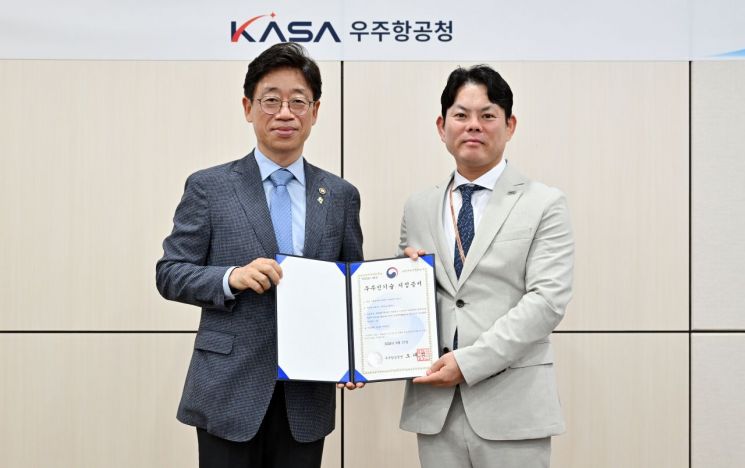
Innospace methane engine core tech gets South Korea 'space new technology' certification

Application
Originally reported by asiae.co.kr
Innospace, a South Korean private aerospace company, announced on June 18 that its methane engine combustion chamber technology has been officially designated as a '2026-1st Space New Technology' by the Korea AeroSpace Administration (KASA). The specific technology, a 'bipropellant regenerative cooling methane engine combustion chamber,' uses liquid methane and liquid oxygen in a novel cooling architecture where both fuel and oxidizer circulate through integrated channels to absorb heat. The company validated this design with a 420-second single-burn test in May, the longest recorded for a domestically developed methane engine in South Korea, following earlier cooling performance tests in February and initial ignition trials in July 2025.
The certification is significant because it explicitly validates Innospace's use of metal additive manufacturing (LPBF/DMLS) to fabricate the complex cooling channels as a single, monolithic part. By consolidating what would traditionally be a multi-component assembly into one 3D-printed structure, Innospace achieved higher design freedom, reduced structural weight, and improved cooling stability at lower chamber pressures-enabling lighter propellant tanks and feed systems. This technology is destined for the 'Hanbit-Micro' launch vehicle's upper-stage methane engine (LiMEK-04), with planned applications extending to reusable launch vehicles, small satellite orbital transfer vehicles, and deep-space propulsion.
For the additive manufacturing industry, this represents a concrete case of AM moving beyond a prototyping tool into certified, mission-critical propulsion hardware. The 'Space New Technology' designation acts as a formal government-backed qualification milestone, similar in function to how aerospace primes use material and process certifications to de-risk adoption. Innospace's next step is to transition this certified engine design from a successful test campaign into a flight-ready production configuration, scaling its AM-based manufacturing from single-engine validation to serial production for the Hanbit-Micro program. The company must now demonstrate repeatable build quality and cost parity with conventionally manufactured alternatives to sustain its competitive position in the emerging small-launcher market.
Topics