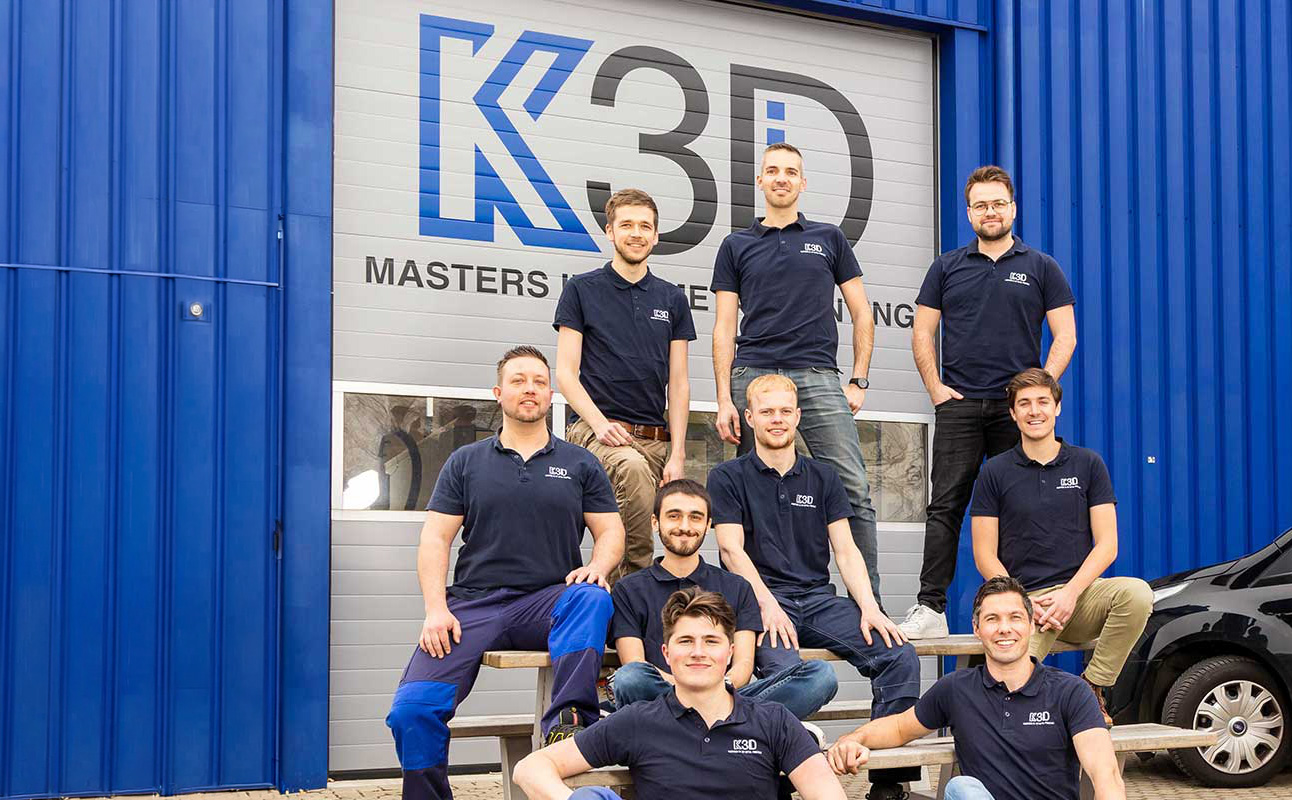
K3D expands MetalFab fleet to six systems across two Dutch sites, hits one million parts

Service
Originally reported by 3Druck
Dutch metal AM service bureau K3D has expanded its production capacity by adding two MetalFab systems, bringing its total fleet to six machines across two manufacturing sites in the eastern Netherlands and the Brainport Eindhoven region. The company now operates nine additive manufacturing cores processing stainless steel 316L, AlSi10Mg, and Ti6Al4V, with configurations ranging from the single-core MetalFab 300 Flex to the fully automated MetalFab G2 Continuous Production. K3D also announced it has produced its one millionth metal part, a milestone reached nearly a decade after acquiring its first MetalFab system in 2016. The company was founded as a subsidiary of Royal Kaak, a Dutch industrial production line manufacturer for baked goods.
This expansion is a concrete example of service-based adoption in metal AM, where value is captured not through machine sales but through repeatable production throughput. K3D's reported 95% utilization rates on its automated MetalFab systems demonstrate that LPBF can achieve factory-floor reliability when operators invest in workflow integration and material discipline. The company serves aerospace, automotive, tooling, energy, oil and gas, and defense customers, placing it at the intersection of multiple demand verticals that increasingly require qualified, documented part production rather than prototyping. With six systems on a single platform, K3D positions itself among the largest European metal AM service providers by installed capacity, competing with firms like Materialise, Oerlikon AM, and ZARE in the production-service segment.
For buyers evaluating metal AM service partners, K3D's track record - one million parts from a single machine platform over a decade - offers a practical reference point. The key takeaway is not the fleet size but the utilization rate and material consistency across two sites, which signal that the company has moved beyond demonstration cells into repeatable production. The next challenge for K3D will be maintaining quality governance as it scales further, particularly across defense and aerospace contracts where qualification documentation is non-negotiable.
Topics