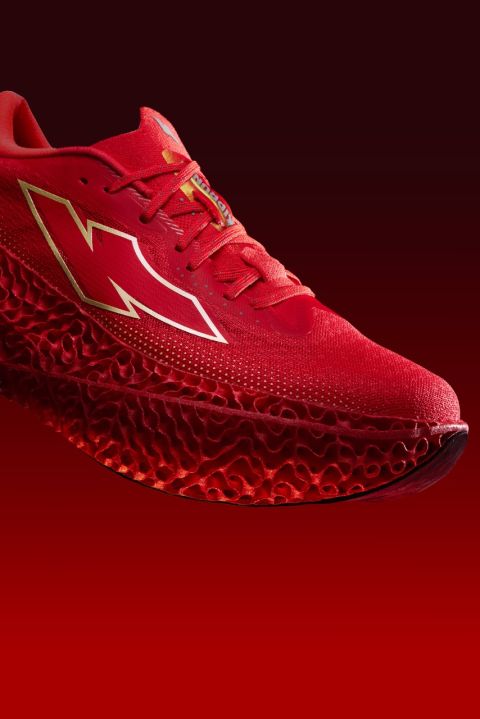
Kiprun launches KIPNEXT 3D running shoe with HP MJF midsole, enters 3D printed footwear market
Originally reported by 3D Printing Industry
Decathlon's performance running brand Kiprun has launched its first 3D printed shoe, the KIPNEXT 3D, entering the additive manufacturing footwear segment. The shoe combines a knitted upper with a 3D printed midsole produced using HP's Multi Jet Fusion process with a proprietary thermoplastic elastomer material. Kiprun claims an energy return of 75%, compared to the 50–65% range typical for EVA foam midsoles, though independent verification has not been published. The project was developed in under six months with support from Barcelona-based footwear production specialist SomethingAdded and Decathlon's Shenzhen innovation hub, and is currently sold exclusively in select Decathlon stores in China at approximately US$250 in limited quantities.
This launch places Kiprun in a rapidly expanding competitive landscape where additive manufacturing in footwear has moved from isolated experiments to a growing wave of production releases. Nike introduced its Air Max 1000 described as its first fully 3D printed sneaker in late 2024, Gucci expanded its Cub3d sneaker line using plant-based materials, and platforms like Zellerfeld have built brand collaborations spanning Nike, Louis Vuitton, and Hugo Boss. The KIPNEXT 3D's hybrid construction approach - additive midsole with conventional upper - mirrors the pragmatic strategy seen across most current footwear AM launches, where the midsole's lattice geometry delivers cushioning differentiation without requiring full-shoe additive production. The 180-day concept-to-product timeline demonstrates the speed-to-market advantage that MJF-based production can offer, though the limited China-only availability and lack of independent performance data mean this remains a controlled market test rather than a scaled commercial rollout.
For Kiprun, the immediate challenge is moving from a limited China launch to broader distribution while building the performance data and runner feedback that will determine whether the 75% energy return claim holds up under real-world use. The footwear AM market has seen multiple brands launch limited runs, but sustained production scale and consumer adoption remain unproven outside niche applications. Kiprun's next step should be expanding availability and publishing independent testing results to validate its performance claims against conventional midsoles.
This article is an AI-assisted rewrite of the linked source report. Facts originate from the source; phrasing is AMPulse's. Use Read Original below to verify, or Report an issue if something is wrong.
Topics