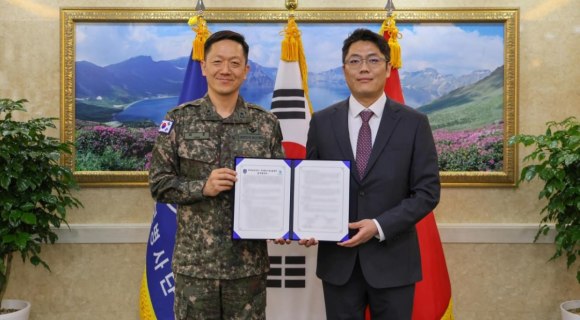
LinkSolution signs MOU with ROK Army 72nd Infantry Division for defense drone additive manufacturing

Hardware
Originally reported by newspim.com
LinkSolution signs MOU with ROK Army 72nd Infantry Division for defense drone additive manufacturing
LinkSolution, a South Korean specialist in 3D printing-based smart manufacturing, signed a memorandum of understanding (MOU) on April 2, 2026, with the ROK Army 72nd Infantry Division to advance defense drone logistics and operational capabilities. The partnership focuses on integrating additive manufacturing to produce optimized drone hardware, utilizing topology optimization for high-stiffness frames and aerodynamic cooling channels. LinkSolution will implement snap-fit modular structures to facilitate field repairs and integrate KCMVP-certified secure communication modules and AI-driven flight systems. The collaboration also includes a training program for soldiers on 3D printing and reverse engineering of obsolete parts, supported by the company's AS9100 aerospace quality management certification.
This initiative reflects the growing integration of distributed manufacturing within military supply chains to mitigate the risks of traditional logistics in contested environments. By leveraging additive manufacturing for rapid field maintenance and part localization, the ROK Army aims to reduce dependency on centralized supply lines for drone components. This approach aligns with broader trends in defense, where agility and decentralized production are prioritized over large-scale inventory management. LinkSolution positions itself as a critical service provider in the K-Defense ecosystem, bridging the gap between high-end aerospace manufacturing standards and tactical field requirements.
For LinkSolution, the success of this partnership depends on the practical reliability of their 3D-printed components under rigorous field conditions. The focus on AS9100-compliant reverse engineering provides a scalable path to sustain legacy equipment, but the company must demonstrate consistent material performance in high-stress drone operations. Future efforts should prioritize the validation of these printed parts against standard military-grade injection-molded or machined alternatives to ensure long-term operational viability.
This article is an AI-assisted rewrite of the linked source report. Facts originate from the source; phrasing is AMPulse's. Use Read Original below to verify, or Report an issue if something is wrong.