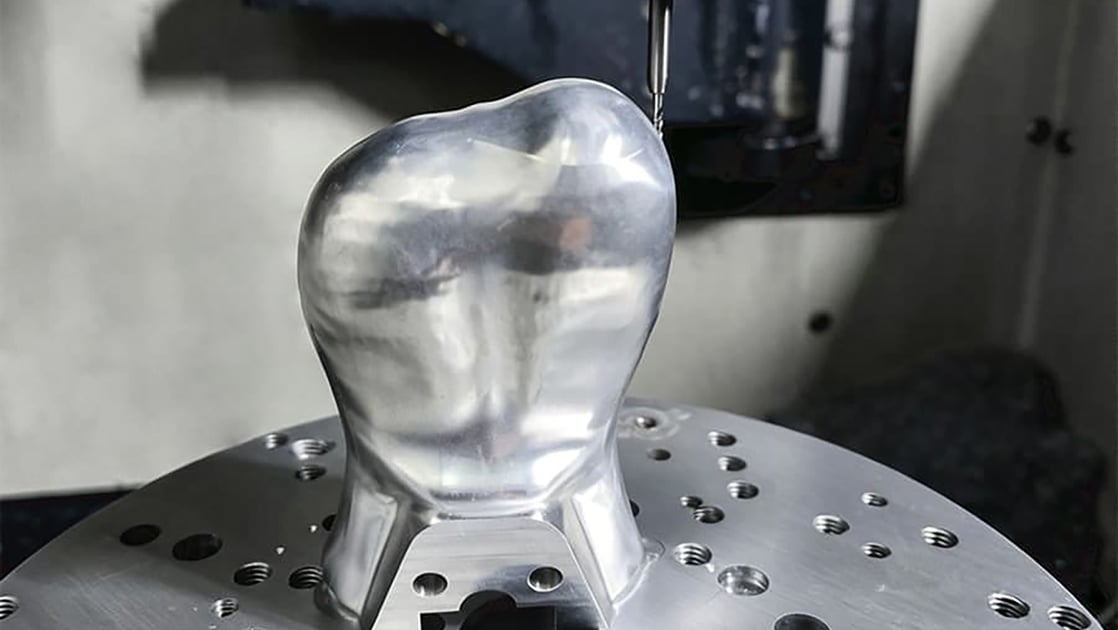
LS Manufacturing Claims ±0.01 mm CNC Workflow for Medical Implant Components

Service
Originally reported by All3DP
LS Manufacturing has announced a CNC machining workflow capable of holding ±0.01 mm tolerances for medical implant components, according to a June 13, 2026 report. The company, which operates across additive and subtractive manufacturing, positions this capability as a post-processing and inspection solution for complex geometries produced via metal AM. No specific machine model, material, or implant type was disclosed, but the claim targets the intersection of 3D-printed near-net shapes and the tight dimensional requirements of orthopedic and dental implants.
This announcement lands in a familiar tension within medical-device manufacturing: AM can produce lattice structures and patient-specific contours that CNC cannot, but it rarely exits the build chamber at final-tolerance surfaces. LS Manufacturing is effectively marketing a hybrid workflow bridge, not a pure-AM breakthrough. The claim fits the recurring pattern where post-processing and metrology infrastructure-not just printer capability-determines whether an AM implant part qualifies for clinical use. In the medical-dental vertical, where FDA 510(k) clearance and ISO 13485 certification govern adoption, a validated CNC finishing step can be the difference between a demo part and a reimbursable product. The real question is whether LS Manufacturing has integrated this workflow with the traceability and audit trails that implant manufacturers require, or whether this remains a standalone machining capability marketed alongside AM services.
For buyers evaluating implant production workflows, the practical takeaway is that ±0.01 mm claims require independent verification with certified metrology equipment and documented process repeatability across multiple builds. LS Manufacturing needs to publish case studies showing specific implant geometries, materials (likely Ti-6Al-4V or CoCr), and inspection data before this claim moves from marketing to procurement criteria. Until then, it is a capability assertion, not a qualified process.
This article is an AI-assisted rewrite of the linked source report. Facts originate from the source; phrasing is AMPulse's. Use Read Original below to verify, or Report an issue if something is wrong.
Topics