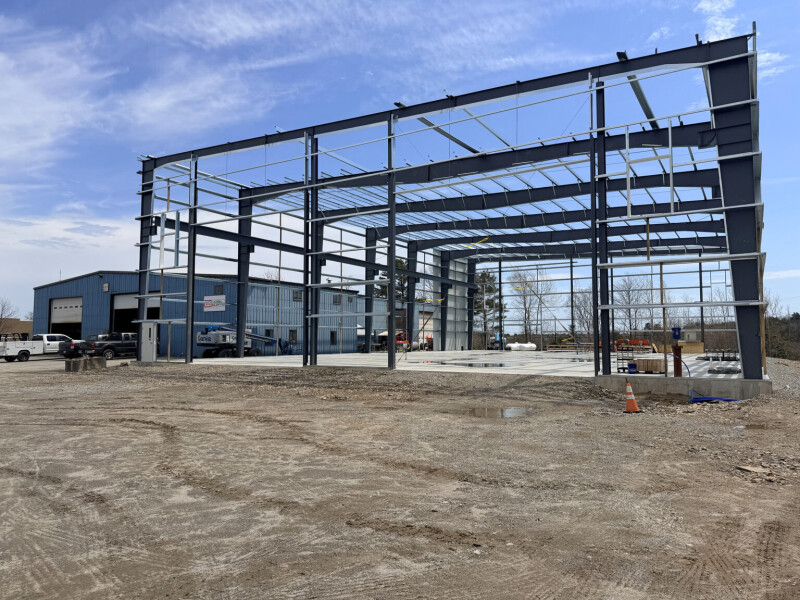
Lyman-Morse breaks ground on 15,000-sq.-ft. Advanced Composites Center in Thomaston, Maine

Application
Originally reported by workboat.com
Maine-based boatbuilder Lyman-Morse has begun construction on a 15,000-sq.-ft. Advanced Composites Center at its Elltee Circle campus in Thomaston, Maine. The facility will house composite fabrication, rapid prototyping, structural component manufacturing, and stainless-steel additive manufacturing using SS316L 3D printing technology. The building includes radiant-floor heating, two 5-ton overhead cranes, and integrated compressed air and vacuum systems, and is expected to be completed in summer 2026. The project received support from the Maine Technology Institute’s Maine Technology Asset Fund (MTAF3.0) and will be ITAR compliant.
This expansion is significant because it consolidates Lyman-Morse’s existing metal additive manufacturing capability-anchored by an EOS M290 LPBF system-with new composite fabrication under one roof, creating a multi-material advanced manufacturing hub for marine, industrial, and defense applications. The move reflects a broader trend in the marine and defense sectors where shipbuilders are integrating AM alongside traditional composites to reduce lead times on custom-engineered assemblies and replacement parts. Lyman-Morse’s existing workboat division builds aluminum vessels for commercial and government customers, and the new center positions the company to capture defense contracts requiring ITAR-compliant, multi-process manufacturing-a pattern consistent with the defense vertical’s politically accelerated adoption wave in 2025-2026.
From a practical standpoint, Lyman-Morse is executing a sensible vertical integration strategy: rather than outsourcing composite or metal-printed components, it is bringing both capabilities in-house to control quality and lead times for its own vessel production and external contract work. The key execution risk is whether the company can achieve sufficient utilization across both the EOS M290 and the new composites line to justify the capital outlay, especially given the relatively small scale of the marine AM market. For buyers in defense and specialty marine, this facility signals a credible single-source partner for complex, multi-material assemblies that previously required coordination across separate suppliers.
Topics