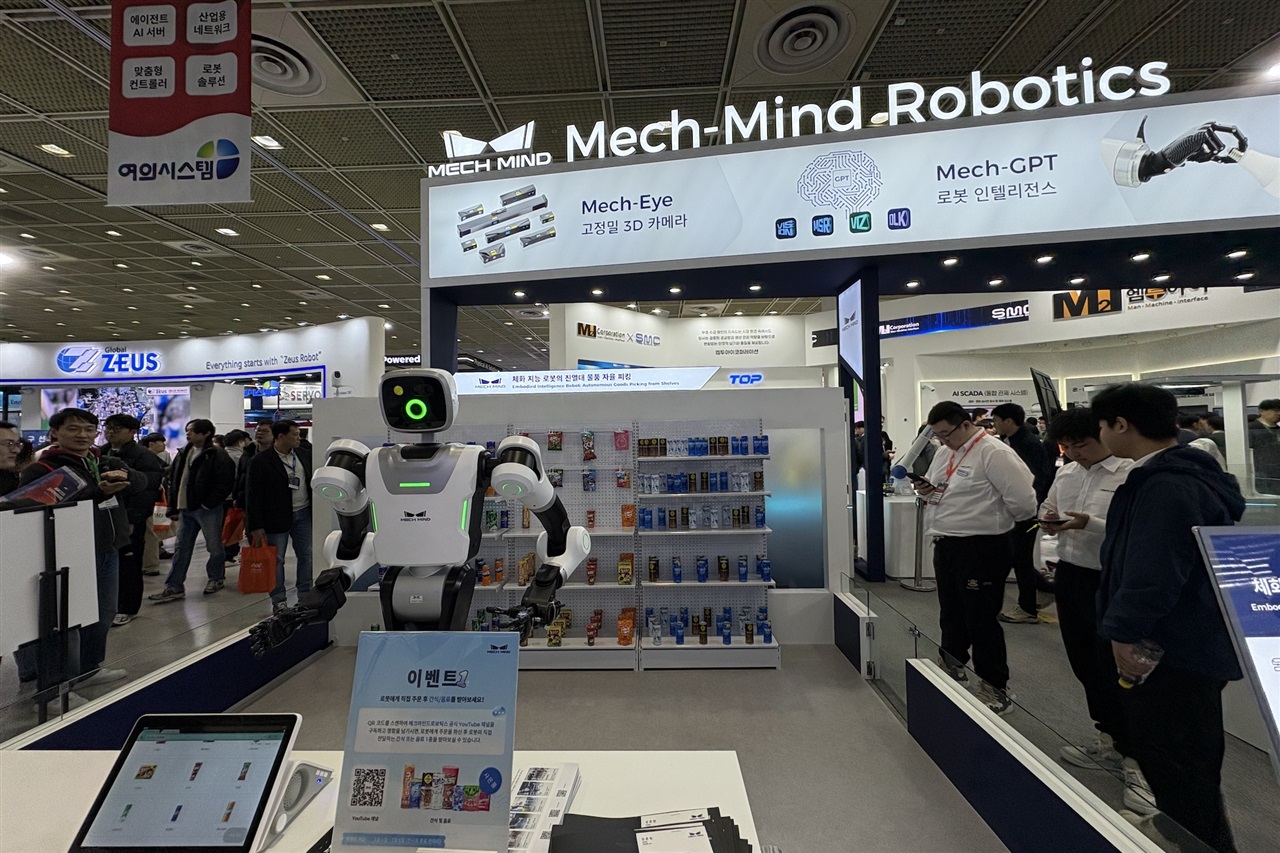
Mech-Mind Robotics announced its strategic pivot toward becoming a global leader in embodied AI during the Automation World 2026 conference in Seoul.
Originally reported by digitimes.com
Mech-Mind Robotics announced its strategic pivot toward becoming a global leader in embodied AI during the Automation World 2026 conference in Seoul. The company, headquartered in Beijing, is leveraging its existing portfolio of 3D vision systems and industrial robot software to integrate high-fidelity spatial perception with generative AI models. By focusing on the convergence of machine vision and autonomous decision-making, Mech-Mind aims to provide the sensory and cognitive stack required for next-generation humanoid and mobile robotics deployments. The initiative focuses on scaling its software-defined hardware solutions to support complex manipulation tasks in manufacturing environments.
This move positions Mech-Mind directly against established robotics vision incumbents like Cognex and Keyence, as well as emerging embodied AI startups integrating vision-language models into industrial workflows. The global industrial robotics market, currently valued at over $50 billion, is increasingly shifting from pre-programmed automation to adaptive, AI-driven systems that require real-time 3D environmental mapping. Mech-Mind occupies a critical position in the value chain by bridging the gap between raw sensor data and actionable robot motion, addressing the persistent bottleneck of unstructured environment navigation. Their ability to deliver low-latency 3D vision processing is essential for the adoption of autonomous mobile robots and collaborative arms in high-mix, low-volume production settings.
Mech-Mind must now demonstrate that its software stack can maintain high inference speeds across diverse hardware platforms without requiring extensive custom integration. For industrial end-users, the focus should remain on the interoperability of these vision systems with existing PLC architectures and the reliability of the AI models in variable lighting or occluded conditions. Success depends on moving beyond laboratory demonstrations to prove consistent uptime in high-throughput factory floor applications.
Topics