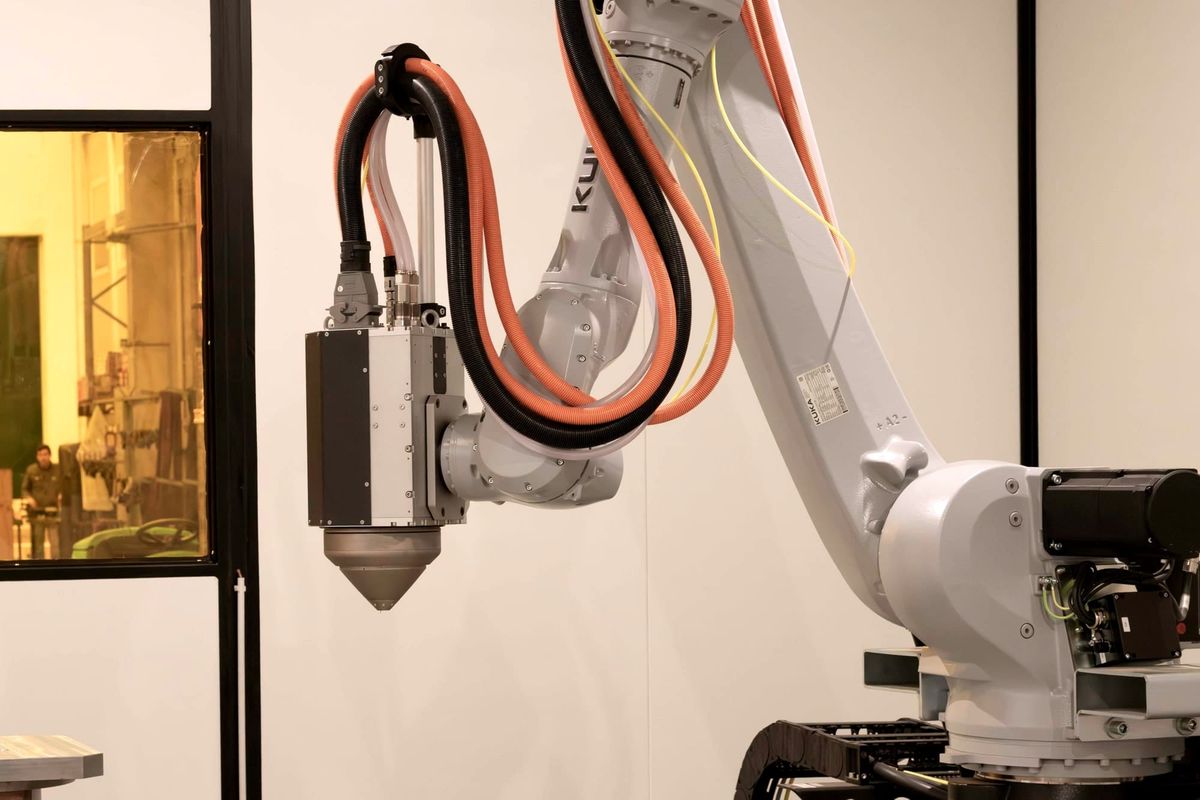
Meltio advances metal DED additive manufacturing for heavy industry, aerospace, and energy

Hardware
Originally reported by TCT Magazine
Meltio, the Linares, Spain-based metal additive manufacturing company founded in 2019, is advancing its Directed Energy Deposition (DED) technology for heavy industry, aerospace, and energy applications. The company's Meltio Engine Robot Integration kit enables manufacturers to convert standard industrial robotic arms into high-precision 3D printing systems for both part production and component repair. A key deployment is at Eurobearings in Cortemaggiore, Italy, which integrated the Meltio head onto a KUKA industrial robot mounted on a mobile gantry within a containerized Robot Cell. This setup allows on-site fabrication and repair of large-scale industrial components such as white metal sliding, thrust, and combined bearings, eliminating traditional size constraints and reducing material waste from up to 80% in conventional subtractive methods.
This development matters because it demonstrates how metal DED is moving beyond experimental applications into robust, production-grade environments for industries with the highest qualification burdens. Meltio's wire-based laser deposition welding process is specifically designed for industrial operating conditions, positioning it against competitors like DMG MORI's Lasertec DED series and WAAM-focused players such as MX3D and WAAM3D. The Eurobearings use case is particularly significant for the energy and heavy industrial verticals, where downtime costs are severe and on-site repair capability directly impacts operational economics. Meltio's approach aligns with the broader industry pattern of customization over rigid platform solutions, addressing a gap where traditional LPBF systems cannot accommodate the scale or material flexibility required for large rotating equipment repair.
From an expert perspective, Meltio's success hinges on execution in three areas: expanding its material portfolio beyond babbitt and common alloys to include high-value aerospace-grade materials like Inconel and titanium, building a service network for robot integration support, and securing qualification documentation from end users in regulated verticals. The company's focus on reproducible processes rather than experimental applications is the right strategy for industrial adoption, but the real test will be whether Eurobearings-style deployments scale beyond single-customer showcases into repeatable, referenceable installations across energy and defense supply chains.
Topics