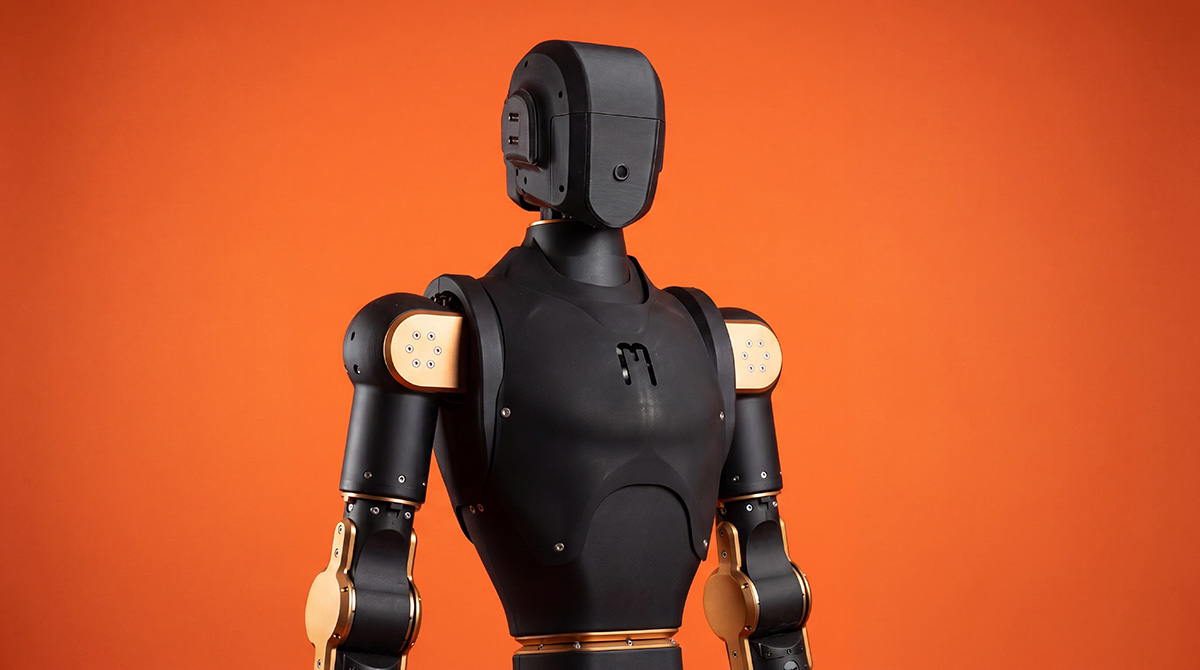
Menlo Research launches $15,000 open-source humanoid robot Asimov with 3D-printed structural parts

Hardware
Originally reported by 3Druck
Singapore-based Menlo Research has unveiled Asimov, a 1.2-meter-tall, 35-kilogram humanoid robot kit priced at $15,000. The platform uses HP Multi Jet Fusion (MJF) for virtually all structural components, deliberately avoiding CNC machining. It ships unassembled with a modular design featuring over 25 degrees of freedom, including a parallel revolute-spherical-universal (RSU) ankle mechanism. A full bill of materials and design files are available on GitHub, allowing users to source components and print replacement parts themselves.
This launch sits in a narrow but active niche: open-source robotics platforms that rely on additive manufacturing for low-volume, customized production. While humanoid robots from Figure, Tesla, and Boston Dynamics target industrial or commercial applications at six- to seven-figure price points, Asimov is clearly a research and hobbyist tool. The use of MJF for load-bearing structures – rather than metal or carbon fiber – limits absolute strength and stiffness, but it dramatically reduces tooling cost and enables the modular, upgradeable design that Menlo Research emphasizes. The company is positioning itself at the intersection of the polymer AM and robotics research verticals, leveraging the service economics of MJF to keep unit costs down.
For the additive manufacturing industry, Asimov is a concrete demonstration of polymer MJF moving beyond prototyping into end-use, load-bearing applications. However, the robot's performance ceiling is defined by material properties – PA12 or similar MJF materials will not match metal or composite alternatives. The success of this platform hinges on community adoption and the quality of the open-source documentation. Researchers should view it as a modular testbed for actuation and control algorithms, not a drop-in replacement for commercial bipeds. It adds a data point to the ongoing question of how deeply polymer AM can penetrate functional robotics.
Topics