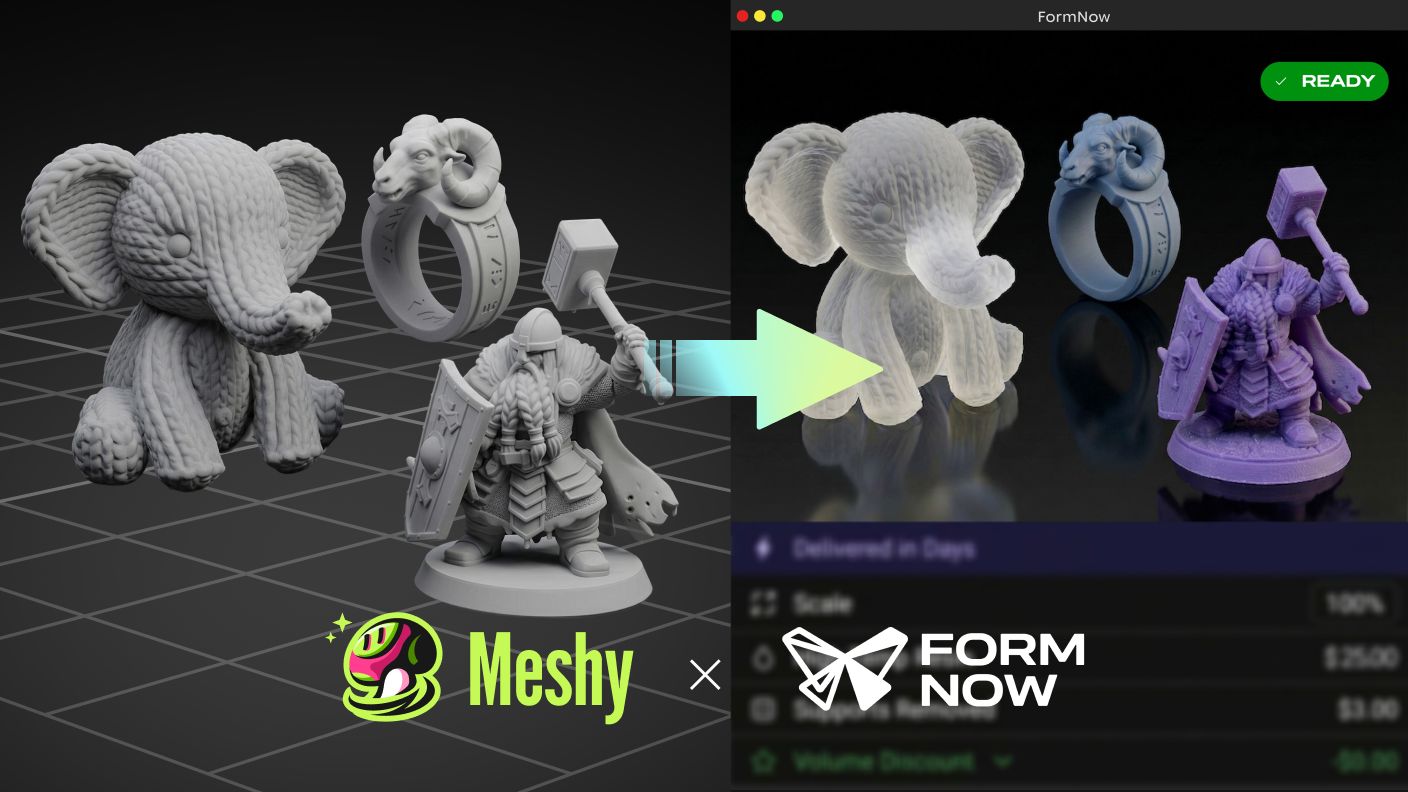
Meshy integrates generative AI 3D modeling with Formlabs Form Now print-on-demand service

Platform
Originally reported by 3D Printing Industry
Meshy.ai, a generative AI platform for 3D content creation, has launched a direct integration with Formlabs' Form Now print-on-demand service. Announced at the RAPID + TCT 2026 conference in Boston, the partnership enables users to move from text or image prompts to physical parts via SLA and SLS manufacturing. The workflow utilizes Meshy's Workspace 3.0 to automate mesh optimization, wall thickness verification, and material compatibility, reporting a 97% slicer pass rate for character and figurine models. Once a model is generated, users select materials and colors through the interface to trigger production at Formlabs' Billerica, Massachusetts facility, with a target turnaround of two days.
This integration addresses the technical friction between generative AI outputs and additive manufacturing requirements, specifically the need for manifold geometry and slicer-ready files. While competitors like Tripo AI focus on high-fidelity asset generation for digital environments, Meshy is positioning itself within the physical manufacturing value chain by bridging the gap between software and hardware. By automating the transition from a digital mesh to a physical object, the company targets the removal of traditional CAD and mesh repair bottlenecks that typically prevent non-specialists from utilizing professional-grade SLA and SLS technologies. This moves the AI application from purely aesthetic digital content to functional, physical prototyping and consumer goods.
For this integration to scale beyond figurines and decorative items, Meshy must demonstrate that its automated mesh optimization can handle the tighter tolerances and complex geometries required for industrial engineering applications. The success of this model depends on the reliability of the automated geometry cleanup to maintain dimensional accuracy during the transition from AI-generated mesh to SLA/SLS print files. Users should evaluate the platform's ability to handle more complex mechanical constraints as the service expands beyond the Creative Lab consumer segment.
This article is an AI-assisted rewrite of the linked source report. Facts originate from the source; phrasing is AMPulse's. Use Read Original below to verify, or Report an issue if something is wrong.