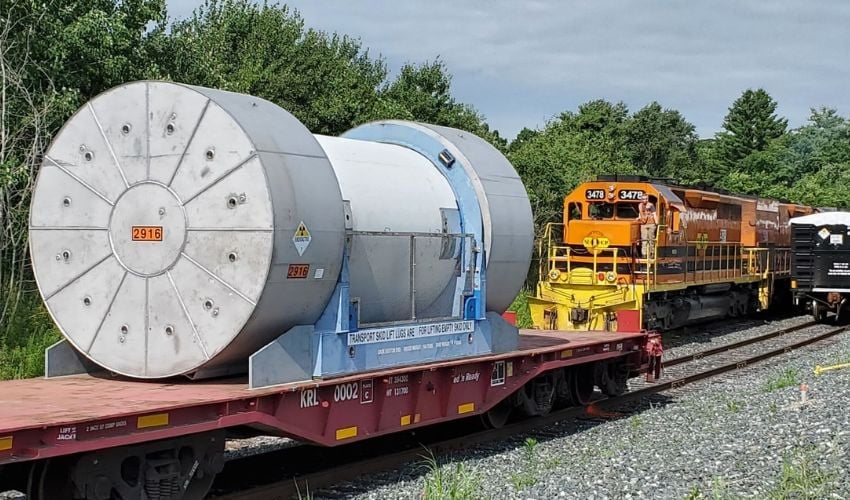
Orano explores 3D-printed shock absorbers for nuclear fuel transport using FFF and LPBF technologies

Application
Originally reported by 3DNatives
Orano Federal Services, in collaboration with the University of North Carolina at Charlotte, has revived a multi-year study to develop additive manufacturing solutions for spent nuclear fuel transport containers. The research focuses on replacing traditional balsa wood, redwood, or aluminum shock absorbers with 3D-printed structures designed to withstand extreme drops, fires, and impacts. The team is evaluating two distinct pathways: Laser Powder Bed Fusion (LPBF) using Nikon SLM Solutions hardware to create an assembly of 442 metal blocks, and Fused Filament Fabrication (FFF) to produce 36 larger blocks. By utilizing Gyroid and honeycomb infill patterns, the study aims to optimize energy absorption while significantly reducing component mass.
This development addresses a critical cost and weight bottleneck in the nuclear logistics value chain, where traditional shock absorber components can cost between $250,000 and $1,000,000 per unit. The shift toward additive manufacturing allows for precise control over material density, with Gyroid designs demonstrating an 80% weight reduction and improved multi-directional strength compared to conventional methods. For the nuclear sector, the ability to move from monolithic or heavy organic materials to optimized lattice structures offers a path toward more efficient, lighter-weight transport shielding. The economic incentive is substantial, as the team estimates potential savings exceeding $1,000,000 for an FFF design utilizing a 5% infill density.
While the technical performance of these lattice structures is proven, the primary hurdle remains the absence of established nuclear-grade certification standards for additive manufacturing processes. Orano must now navigate the regulatory requirements for structural reliability and long-term material stability in high-radiation environments. Success depends on validating that LPBF and FFF-produced components meet the rigorous safety protocols required for transporting hazardous nuclear waste. The next phase of execution requires bridging the gap between successful laboratory prototyping and standardized industrial production.
This article is an AI-assisted rewrite of the linked source report. Facts originate from the source; phrasing is AMPulse's. Use Read Original below to verify, or Report an issue if something is wrong.