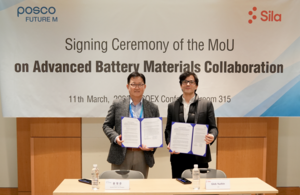
POSCO Future M and Sila Nanotechnologies signed a memorandum of understanding on March 11, 2025, in Seoul to co-develop advanced silicon anode materials for next-generation lithium-ion batteries.
Originally reported by biz.heraldcorp.com
POSCO Future M and Sila Nanotechnologies signed a memorandum of understanding on March 11, 2025, in Seoul to co-develop advanced silicon anode materials for next-generation lithium-ion batteries. The partnership leverages POSCO Future M's expertise in cathode and anode materials alongside Sila's proprietary silicon anode technology, which aims to increase energy storage capacity by up to 10 times compared to traditional graphite-based anodes. Hong Young-jun, head of POSCO Future M's technology research center, and Gleb Yushin, co-founder and CTO of Sila, led the agreement, which also includes exploring the application of carbon material technology to reduce production costs and improve structural stability.
This collaboration addresses the critical challenge of volume expansion and structural degradation inherent in silicon-based anodes during charge and discharge cycles. By integrating carbon-nanomaterial solutions, the companies aim to enhance battery cycle life and charging speeds, positioning themselves to capture a larger share of the electric vehicle battery market. While competitors like Group14 Technologies and Enovix are also advancing silicon-anode architectures, this partnership strengthens the vertical integration of the South Korean supply chain by combining POSCO's material manufacturing scale with Sila's established production capabilities in Moses Lake, Washington.
The partnership signals a shift toward higher-performance anode materials as the automotive industry demands longer range and faster charging times. Future milestones will likely focus on scaling the manufacturing process to achieve cost parity with conventional graphite anodes, a key requirement for mass-market EV adoption. Industry observers should monitor upcoming pilot production results and potential integration into the supply chains of major North American and South Korean automotive OEMs.
This article is an AI-assisted rewrite of the linked source report. Facts originate from the source; phrasing is AMPulse's. Use Read Original below to verify, or Report an issue if something is wrong.
Topics