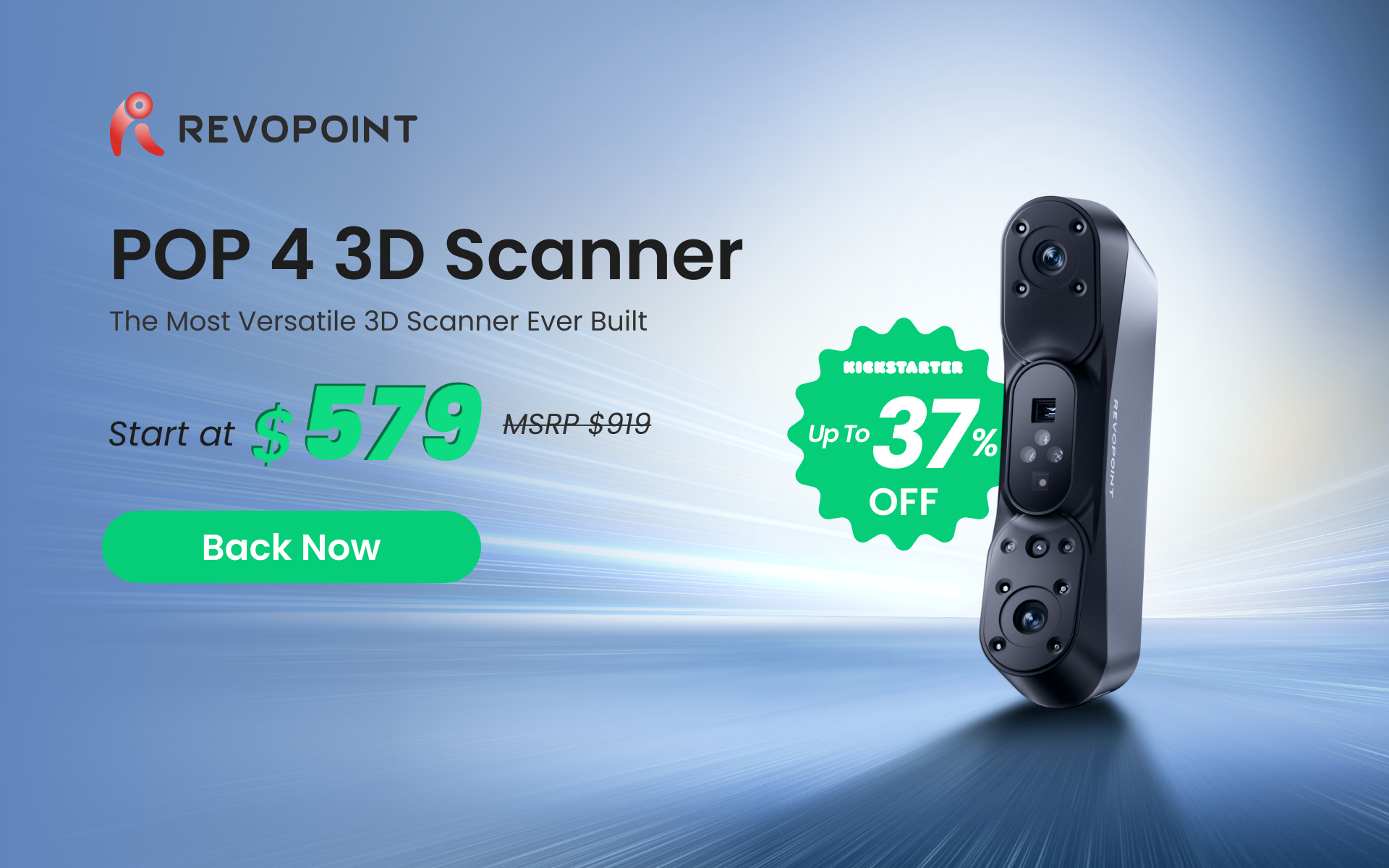
Revopoint launches POP 4 3D scanner on Kickstarter at $579 with hybrid structured light and blue laser modes

Hardware
Originally reported by 3D Printing Industry
Revopoint has launched the POP 4 3D scanner on Kickstarter today, priced at $579 for early backers. The handheld scanner combines five scanning modes - two near-infrared structured light modes for general objects and speed, a dual-projector mode for fast surface capture, and two blue laser modes (30-crossed-line and single-line) for high-reflectivity and dark materials. Key specifications include a fused point distance of 0.05 mm, volumetric accuracy down to 0.03 mm + 0.05 mm/m in laser modes, a frame rate of 105 fps in multi-line laser mode, and a working distance of 200 to 800 mm. The POP 4 is rated for outdoor use up to 100,000 lux, enabling operation in direct sunlight. Software additions include real-time AI object segmentation and 3D Gaussian Splatting output in .splat format for VR/AR workflows.
This launch addresses a persistent gap in the affordable handheld 3D scanning market: the inability of single-technology scanners to handle mixed surface types. Most consumer-grade scanners rely solely on infrared structured light, which fails on shiny metal and dark surfaces, while blue laser scanners struggle with organic textures. By integrating both technologies into a single device at a sub-$600 price point, Revopoint is targeting the reverse engineering, quality inspection, and digital archiving workflows that previously required equipment costing several thousand dollars. The outdoor capability up to 100,000 lux extends the addressable use cases to archaeological sites and on-site industrial inspection, areas dominated by higher-end systems from Artec 3D and Creaform. The AI segmentation and Gaussian Splatting output also position the POP 4 for emerging applications in VR/AR content creation, though the primary market remains the professional and prosumer scanning segment.
For Revopoint, the POP 4 represents a clear attempt to consolidate its position in the sub-$1,000 scanner category against competitors like Creality's CR-Scan series and Shining 3D's Einstar. The hybrid optical approach is technically sound but execution depends on real-world tracking stability and software reliability, which have been inconsistent in previous Revopoint releases. Buyers should evaluate the scanner's performance on their specific material types before assuming the hybrid modes eliminate all surface challenges. The Kickstarter campaign will reveal whether the technical pitch translates into orders, but the product itself is a legitimate step forward in capability density for the price tier.
This article is an AI-assisted rewrite of the linked source report. Facts originate from the source; phrasing is AMPulse's. Use Read Original below to verify, or Report an issue if something is wrong.
Topics