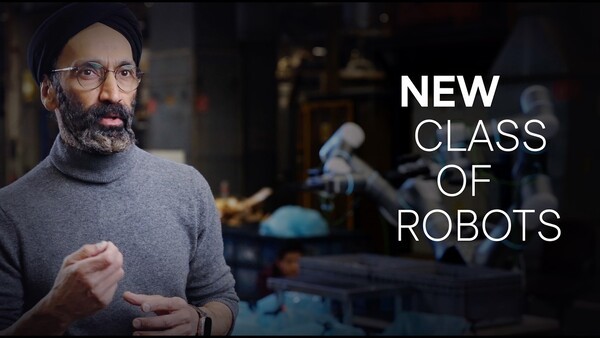
Roda AI has secured $450 million in Series A funding to scale its robotics foundation model, FutureVision, and transition from stealth mode.
Originally reported by irobotnews.com
Roda AI has secured $450 million in Series A funding to scale its robotics foundation model, FutureVision, and transition from stealth mode. The funding round included participation from Capricorn Investment Group, Khosla Ventures, Lightmotif, Matter Venture Partners, Mayfield, Premji Invest, Prelude Ventures, Temasek, and Zora. Led by CEO Jagdeep Singh, the company is deploying a video-predictive control architecture that utilizes internet-scale video data to train robots on physical laws and interaction dynamics before fine-tuning on specific hardware. The system, known as Direct Video Action, operates in a closed-loop cycle at sub-millisecond intervals to enable real-time adaptation to environmental variability in industrial manufacturing settings.
This development addresses the critical limitation of current Vision-Language-Action models, which often struggle with the unpredictable workflows and unstructured environments typical of factory floors. While competitors focus on rigid, pre-programmed automation or laboratory-bound AI, Roda AI aims to bridge the gap between digital intelligence and physical execution by reducing the need for extensive teleoperation data to just 10 hours for new tasks. By prioritizing physical world understanding over static task mapping, the company positions itself as a critical software layer in the industrial robotics value chain, potentially reducing the deployment time for complex assembly and material handling tasks. The ability to achieve cycle times under two minutes in high-capacity manufacturing evaluations suggests a shift toward more autonomous, general-purpose industrial robotics.
This capital infusion signals a broader industry trend toward integrating generative AI with physical control loops to enhance the flexibility of automated production lines. As Roda AI moves to license its FutureVision intelligence layer to third-party hardware and software platforms, the industry should monitor the integration of these models into existing robotic arms and mobile manipulators. The successful deployment of this technology could significantly lower the barrier to entry for automating high-mix, low-volume production environments that have historically relied on manual labor due to the complexity of environmental changes.
This article is an AI-assisted rewrite of the linked source report. Facts originate from the source; phrasing is AMPulse's. Use Read Original below to verify, or Report an issue if something is wrong.
Topics