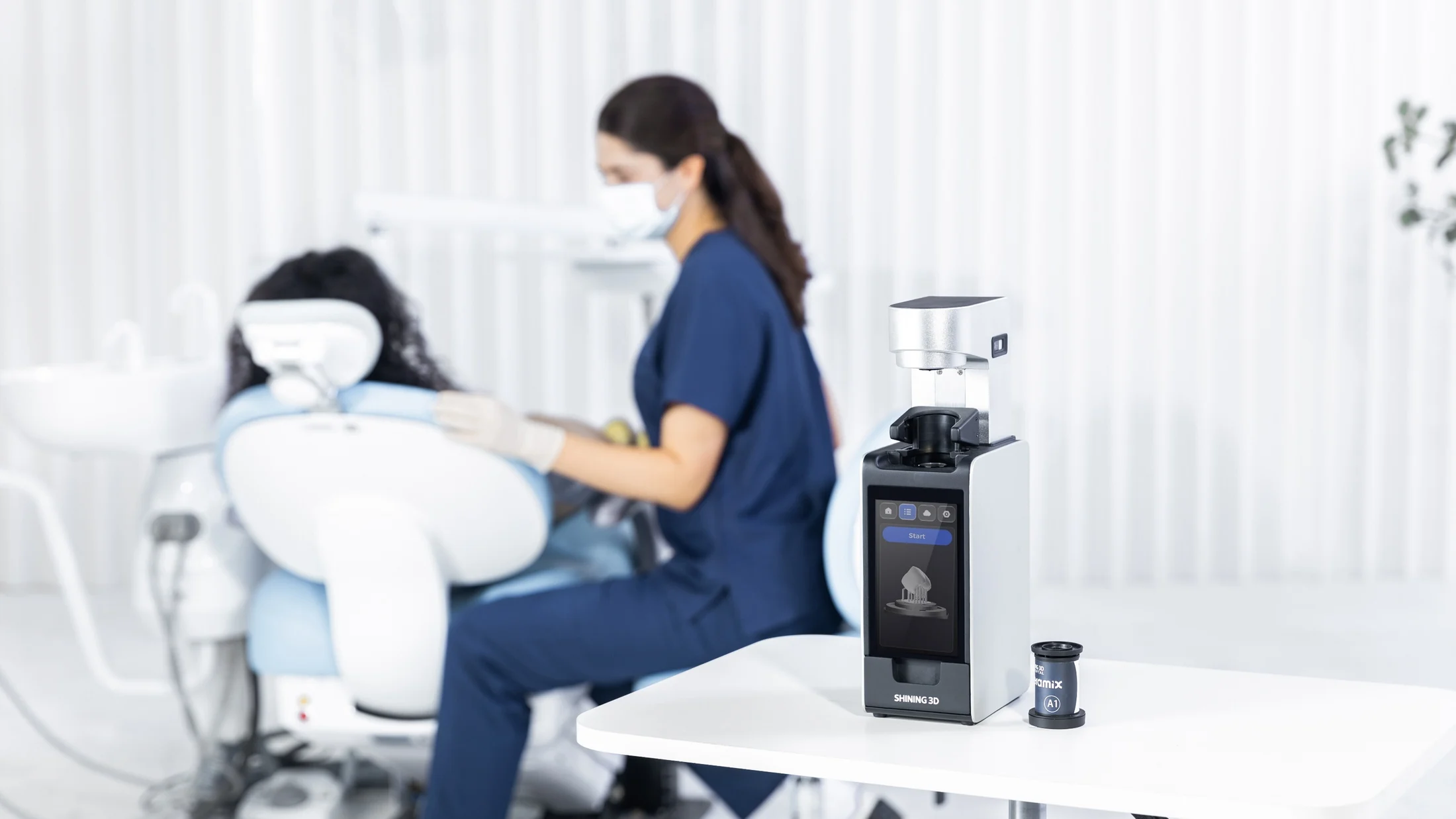
SHINING 3D Dental launches Ceramix-Nano chairside ceramic 3D printer with 30-minute workflow

Hardware
Originally reported by 3D Printing Industry
SHINING 3D Dental, the dental division of Chinese company SHINING 3D, commercially launched the Ceramix-Nano on June 18, 2026, a compact chairside ceramic 3D printer weighing 2 kg and roughly shoebox-sized. The system uses patented APS (Adaptive Pneumatic Stereolithography) technology to print and cure permanent restorations-crowns, veneers, inlays, onlays, and Maryland bridges-in a single enclosure. Each proprietary LumiCera resin capsule yields up to three restorations, and the full scan-to-cementation workflow via the SHINING FLOW cloud platform completes in as little as 30 minutes: design in under two minutes, printing in 8–11 minutes, and curing in three. The LumiCera material carries FDA Class II 510(k) clearance and is available in five VITA shades. The printer is now shipping in North America and Asia through authorized distributors, with EU availability expected shortly.
This launch places SHINING 3D Dental squarely in the intensifying race for chairside ceramic printing, a segment where print times under 15 minutes and integrated workflows are becoming the competitive baseline. The global dental 3D printing market was approximately $5.2 billion in 2024 and is forecast to approach $10 billion by 2033, with roughly 15% of U.S. dental practices now owning an in-office printer-up from near zero a decade ago. SHINING 3D’s approach mirrors the stack-economics play seen across medical-dental AM: coupling hardware to validated resins, cloud software, and capsule-based material handling to reduce operator skill requirements and protect recurring revenue. Competitors such as PioCreat’s PioNext Mini and systems from SprintRay and Stratasys Dental are also targeting the same same-visit restoration workflow, but SHINING 3D differentiates through its fully enclosed print-and-cure architecture and the capsule system that eliminates manual resin handling and calibration.
For dental practices evaluating chairside AM, the Ceramix-Nano’s practical significance lies in its reduction of workflow complexity and physical footprint. The capsule system and self-configuring printer lower the barrier for clinics without dedicated lab technicians, while the FDA clearance on LumiCera removes a qualification hurdle. SHINING 3D Dental must now demonstrate reliable clinical outcomes at scale and build a service network that matches the responsiveness of established dental OEMs. Buyers should verify local distributor support and material availability before committing to the ecosystem.
Topics