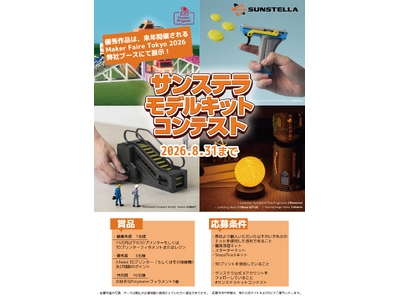
Sunstella launches model kit design contest with 3D printers, prizes up to ¥150,000

Service
Originally reported by SEKAPRI
Sunstella, a Japanese distributor of 3D printing hardware and materials, has announced a "Model Kit Design Contest" open to users of its products. The contest runs from April 23 to August 31, 2026, and is open to anyone who submits a 3D-printed model made using a kit purchased from Sunstella. The grand prize is a 3D printer valued at up to ¥150,000, with additional prizes including an AImini 3D printer and five spools of Polymaker filament. Winning entries will be displayed at Sunstella's booth during Maker Faire Tokyo 2026 on September 5–6 at Tokyo Big Sight. Sunstella reports over 10 years in the AM distribution business, selling approximately 3,500 units annually across multiple brands, and positions itself as a full-service partner for Japanese users.
This contest is a low-stakes community engagement play, not a product launch or technology milestone. It targets the polymer FDM/FFF hobbyist and prosumer segment in Japan, a market where Sunstella competes with other local distributors like APPLE TREE and global brands such as Bambu Lab. The event's significance lies in its reinforcement of Sunstella's role as a channel partner rather than an innovator - the company does not manufacture its own hardware or materials. The contest format is a common tactic among AM distributors to drive kit sales and build brand loyalty among entry-level users, a segment that remains price-sensitive and community-driven. Japan's consumer 3D printing market is modest compared to industrial AM, but events like Maker Faire Tokyo provide visibility for distributors seeking to differentiate through service and community support.
For Sunstella, the contest's success will be measured by submission volume and subsequent kit sales, not by technical breakthroughs. The company's long-term relevance depends on maintaining strong relationships with upstream suppliers like Polymaker and on providing reliable after-sales support in a market where user trust is a key differentiator. This is a routine marketing initiative, not a signal of strategic shift.
This article is an AI-assisted rewrite of the linked source report. Facts originate from the source; phrasing is AMPulse's. Use Read Original below to verify, or Report an issue if something is wrong.