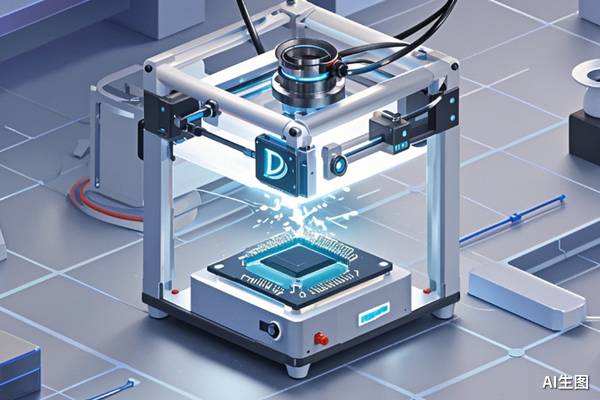
Texas Instruments DLP Technology Enables High-Precision Light-Based Additive Manufacturing Applications

Hardware
Originally reported by 36Kr
Texas Instruments DLP Technology Enables High-Precision Light-Based Additive Manufacturing Applications
Texas Instruments continues to supply Digital Light Processing (DLP) chipsets for industrial and professional-grade vat photopolymerization 3D printers. These DMD (Digital Micromirror Device) chipsets provide pixel resolutions ranging from 7 to 13 micrometers, enabling high-throughput layer-by-layer exposure rather than point-based scanning. The technology operates within the 363nm to 700nm wavelength range, supporting the curing of various photopolymer resins for applications including rapid prototyping, mold manufacturing, and direct part production.
The integration of DLP technology into additive manufacturing addresses the demand for high-speed, high-resolution production where build speed remains independent of part complexity or quantity. By utilizing programmable micro-mirrors, manufacturers can achieve consistent micron-level accuracy across the entire build area, positioning these chipsets as a standard component for light-based AM systems. This hardware-level capability competes with laser-based SLA and LCD-masked systems by offering superior optical efficiency and long-term reliability in extended duty cycles.
For system integrators, the selection of a DLP chipset requires balancing specific DMD dimensions and pixel pitch against the required feature size and resin curing wavelengths. Manufacturers should prioritize the thermal management and optical path design to fully leverage the throughput advantages of the DMD architecture. This technology remains a foundational element for firms scaling production-grade photopolymer AM systems.
Topics