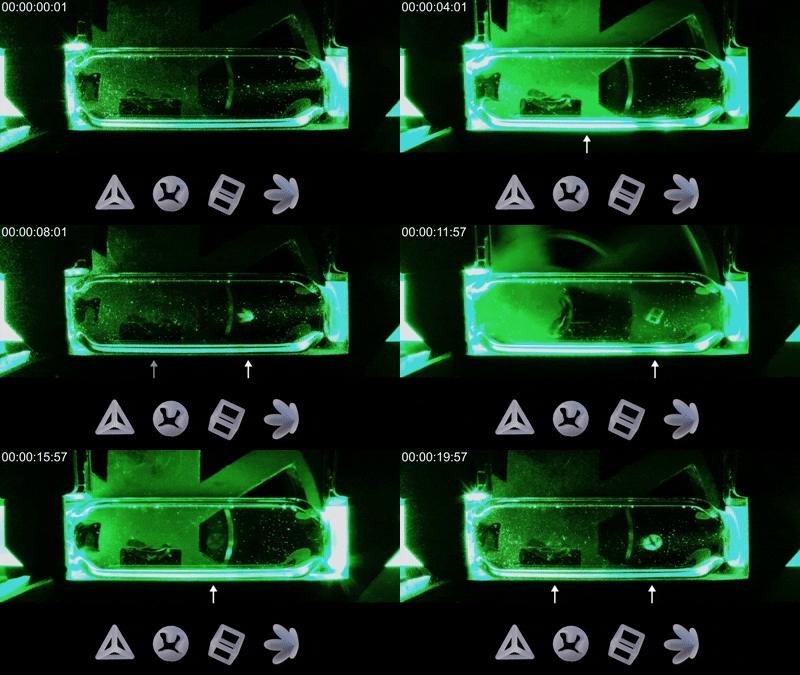
Tsinghua University researchers achieved a record 0.6-second 3D printing speed for millimeter-scale objects using Digital Incoherent Synthetic Holographic Light Field (DISH) technology.
Technology
1 min read

Tsinghua University researchers achieved a record 0.6-second 3D printing speed for millimeter-scale objects using Digital Incoherent Synthetic Holographic Light Field (DISH) technology.

Originally reported by ecns.cn

Tsinghua University researchers achieved a record 0.6-second 3D printing speed for millimeter-scale objects using Digital Incoherent Synthetic Holographic Light Field (DISH) technology. With a 333 mm3/s processing rate and 12-micrometer resolution, this method enables instantaneous production of complex geometries. By projecting 3D light patterns in a single step, DISH removes the mechanical limits of layer-by-layer scanning. This shift to sub-second manufacturing transforms the production of photonic chips, micro-robotics, and optics. 🚀🔬 #3DPrinting #AdditiveManufacturing #Technology #Innovation #TsinghuaUniversity

How This Connects

6 related events
  1. Same pattern

    Sandia National Laboratories and Savannah River National Laboratory have introduced Lithographic Crystallinity Regulation in Additive Fabrication of Thermoplastics (CRAFT), a light...

  2. Same pattern

    City University of Hong Kong researchers have developed 3D-printed biomimetic smart materials inspired by sea urchin spines that generate voltage from water flow.

  3. Same pattern

    Tsinghua University has set a new benchmark in volumetric additive manufacturing with DISH technology.

  4. This article

    Tsinghua University researchers achieved a record 0.6-second 3D printing speed for millimeter-scale objects using Digital Incoherent Synthetic Holographic Light Field (DISH) technology.

  5. Same pattern

    MIT has unveiled a computational framework to 3D print soft, woven metamaterials with internal fiber architectures.

  6. Same pattern

    The μRepRap project has achieved 10-micron feature sizes for under $300, matching the scale of early microprocessors.

  7. Same pattern

    TU Eindhoven secured funding to transition volumetric additive manufacturing from laboratory breakthroughs to scalable series production.