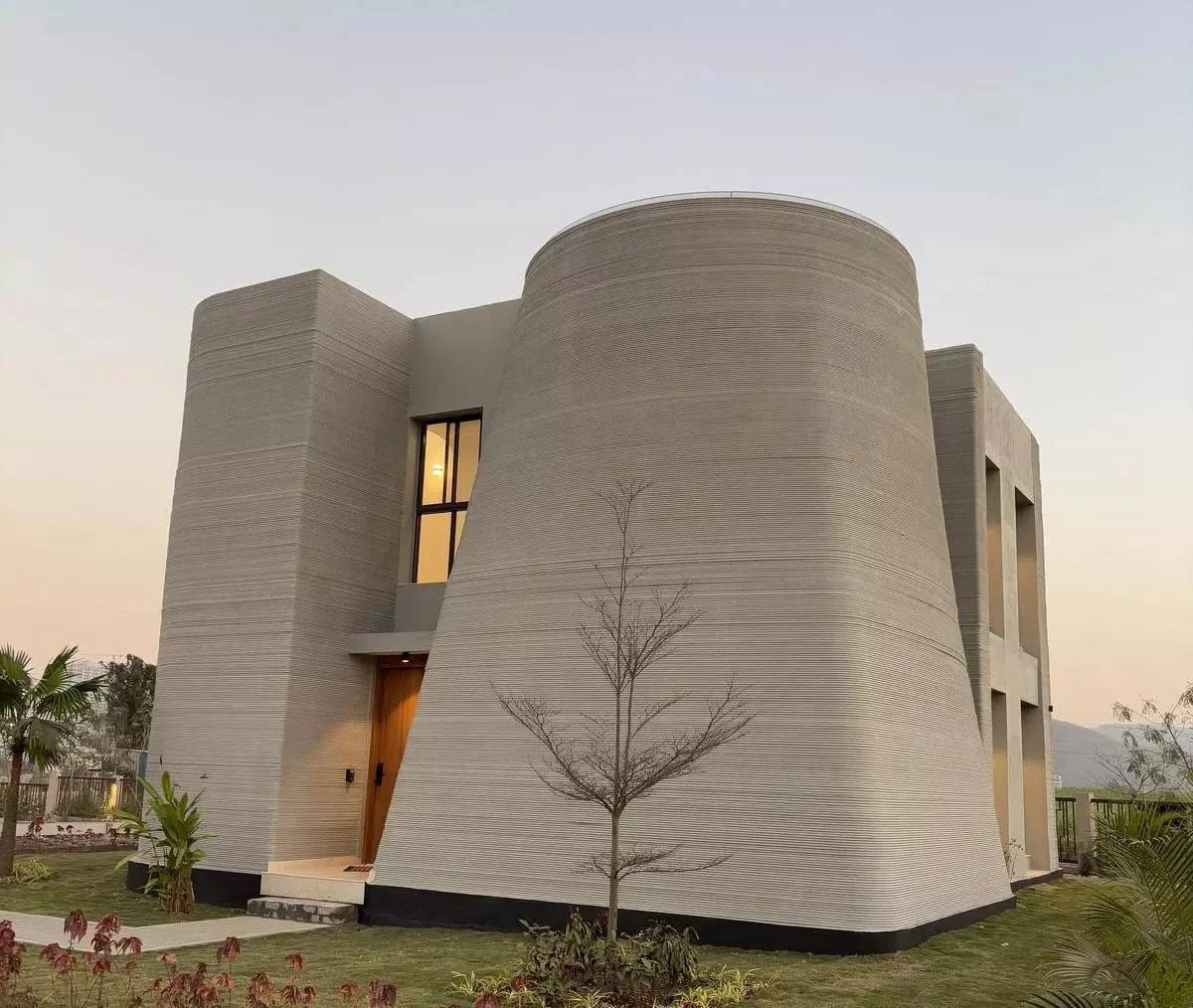
Tvasta and Godrej Properties complete India's first 3D-printed house in Pune

Hardware
Originally reported by parametric-architecture.com
Tvasta Engineering, a Chennai-based deep-tech startup founded by IIT Madras alumni, has completed India's first 3D-printed house in collaboration with Godrej Properties. The G+1 villa, located at Godrej Eden Estate in Pune's Maan Hinjewadi area, spans approximately 2,200 square feet and was built between June and October 2024 using concrete 3D printing technology. The structure was printed layer-by-layer with computer-controlled additive manufacturing, using specially designed concrete mixtures and automated robotics to minimize material waste. Tvasta incorporated recycled construction and industrial waste materials into the process, and the printed walls feature improved thermal insulation for energy efficiency.
This project marks a significant entry point for construction-scale additive manufacturing in India, a market with massive housing demand and chronic labor shortages. The technology addresses the construction industry's need for faster, less labor-intensive building methods, particularly for affordable housing. Tvasta's approach mirrors the Chinese localization arc pattern seen in other AM segments, where local entrants adapt Western construction-printing concepts to domestic supply chains and cost structures. The partnership with Godrej Properties, a major real estate developer, provides the customer references and project scale needed to move beyond demonstration status. The four-month build time for a 2,200 sq ft villa demonstrates meaningful speed advantages over conventional construction, though the technology remains early in its adoption curve for multi-story and large-scale developments.
Tvasta's next practical step is to demonstrate repeatability across multiple projects and extend the technology to multi-story buildings, which requires solving structural certification and material consistency challenges. For the Indian construction sector, this project provides a reference case for evaluating 3D printing against conventional methods on cost, speed, and quality metrics. The real test will be whether the technology can deliver on its promise of affordable housing at scale, not just showcase villas.
Topics