UNIST develops DVAM technology printing complex microstructures like Eiffel Tower in 60 seconds
Originally reported by zdnet.co.kr
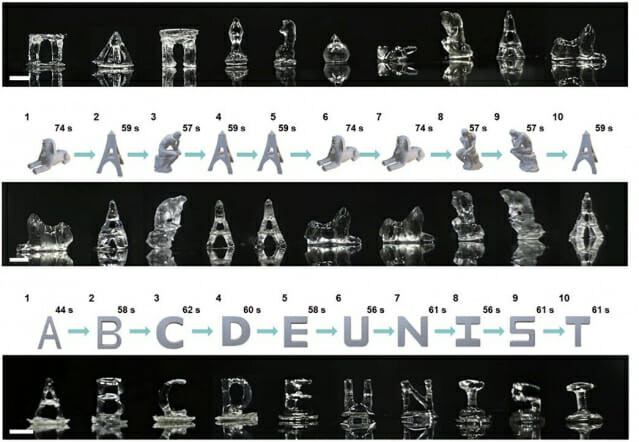
Researchers at the Ulsan National Institute of Science and Technology (UNIST) in South Korea have developed a new high-speed continuous 3D printing technology called Dispensing-based Volumetric Additive Manufacturing (DVAM). Led by Professor Im-Doo Jung of the Department of Mechanical Engineering, the team demonstrated the ability to print complex 3D microstructures - including an Eiffel Tower, a Sphinx, and a thinker figurine - in 45 to 75 seconds per part. The process uses a glass pipette to suspend a droplet of liquid resin, which is then cured by projected light to form the desired shape. After each print cycle, the finished part is ejected onto a substrate and a new resin droplet is replenished within seconds, enabling continuous production of 10 objects in approximately 10 minutes.
This development addresses a fundamental bottleneck in volumetric additive manufacturing: optical distortion caused by the curved surface of the resin droplet and the refractive index mismatch between the droplet and surrounding fluid. UNIST's solution combines a deep learning-based object detection algorithm to extract the droplet profile in real time with an inverse ray-tracing algorithm based on Snell's law to correct light paths and energy dose at the pixel level. The result is a dramatic improvement in print fidelity, measured by Intersection over Union (IoU), for geometries including cubes, pyramids, star pillars, hollow cavities, and thin lattice beams as fine as 150 micrometers. This places DVAM in the emerging category of high-speed, high-resolution micro-AM, competing with two-photon polymerization systems from Nanoscribe and multiphoton lithography tools, but with a continuous-flow architecture that could enable scalable production rather than single-part batch processing.
For UNIST, the practical next step is demonstrating that the refractive correction algorithm and droplet replenishment mechanism can maintain consistent print quality over hundreds or thousands of cycles without drift. The technology is currently at the lab-scale proof-of-concept stage; moving from a single-pipette setup to an arrayed or parallelized system will determine whether DVAM can transition from a research demonstration to a viable production tool for micro-optics, microfluidics, or biomedical scaffolds. Buyers in those verticals should watch for published cycle-life data and third-party replication before evaluating the technology against established micro-AM alternatives.
This article is an AI-assisted rewrite of the linked source report. Facts originate from the source; phrasing is AMPulse's. Use Read Original below to verify, or Report an issue if something is wrong.
Topics