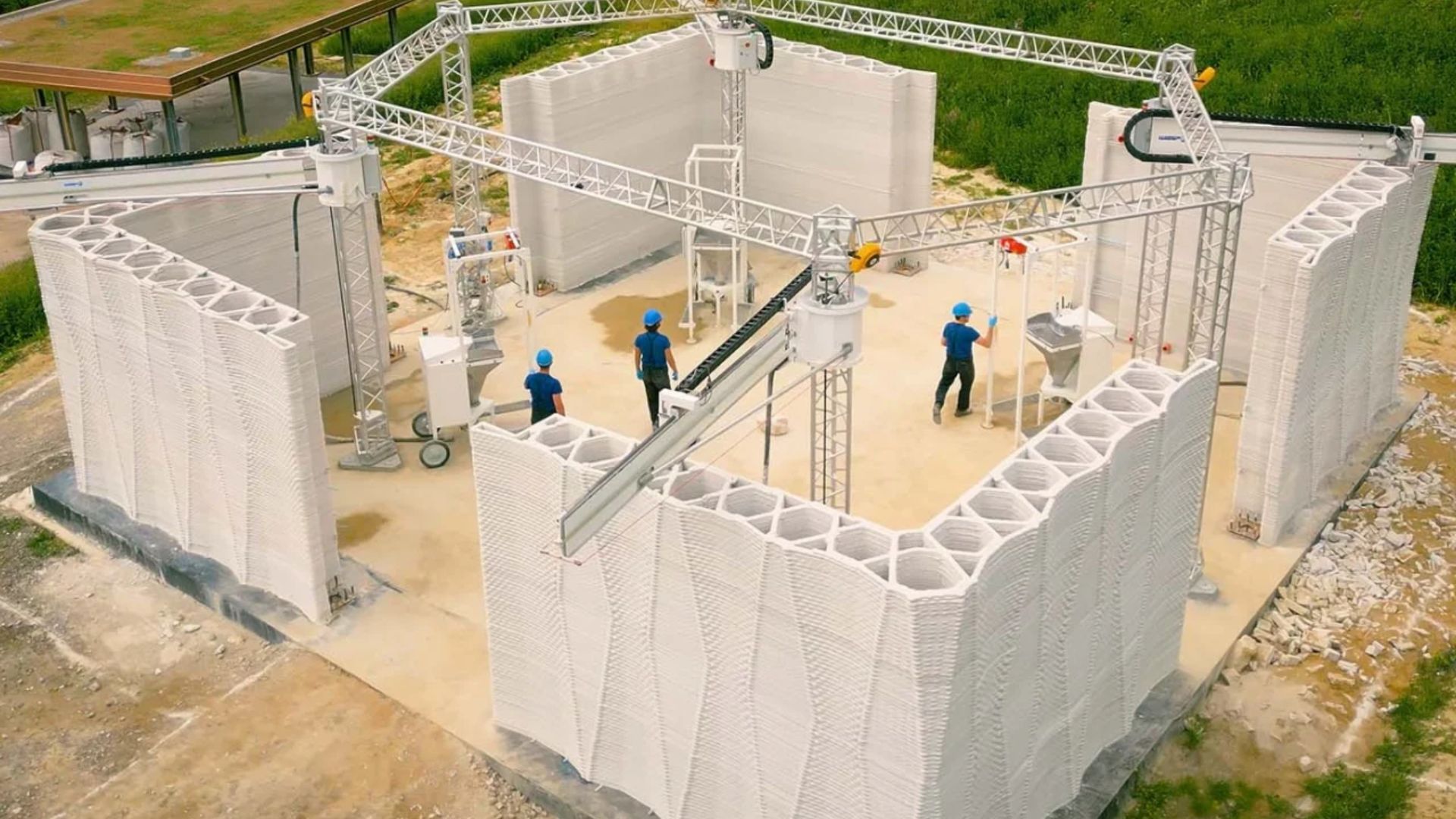
WASP completed the Itaca project in Italy using four synchronized robotic arms to 3D print 164.9 square meters of earthquake-resistant walls in two days.
Technology
1 min read

WASP completed the Itaca project in Italy using four synchronized robotic arms to 3D print 164.9 square meters of earthquake-resistant walls in two days.

Originally reported by Interesting Engineering

WASP completed the Itaca project in Italy using four synchronized robotic arms to 3D print 164.9 square meters of earthquake-resistant walls in two days. This marks the first 3D-printed building certified under European seismic standards, using a concrete-free lime mixture and rice husk insulation. The multi-arm coordination proves modular robotics can meet rigid structural codes while cutting timelines. This signals a major shift toward scalable, bio-based additive construction. 🌍🏗️ #3DPrinting #ConstructionTech #Sustainability #WASP #AdditiveManufacturing

How This Connects

6 related events
  1. Same pattern

    The University of Oklahoma and Oak Ridge National Laboratory have launched Phase II of an $8.8 million additive manufacturing research program in partnership with the Air Force Sus...

  2. Same pattern

    The U.S. Navy awarded Castelion a $50 million contract to advance the Blackbeard hypersonic system toward operational status by late 2027.

  3. Same pattern

    PRINT&GO is scaling its 3D GUN'T module across 420,000 users to automatically block 3D-printed firearm components.

  4. This article

    WASP completed the Itaca project in Italy using four synchronized robotic arms to 3D print 164.9 square meters of earthquake-resistant walls in two days.

  5. Same pattern

    India has extended its deep tech startup status to 20 years and raised the revenue cap to 3 billion rupees to support long-horizon growth.

  6. Same pattern

    Adafruit recently showcased its NeoPixel Light Slate while highlighting the systemic threat of Washington bill HB 2321.

  7. Same pattern

    Beam Intelligent has completed its 42,000 sqm Linfen factory, catapulting annual metal powder capacity to over 5,000 tons.