
Written by AMPulse’s research pipeline. Sources are linked inline.
A cluster of clinical milestones on January 15 signals the transition of Medical AM from structural titanium replacements to resorbable, regenerative scaffolds. The era of 'permanent hardware' is ending.
Executive Summary: The Era of 'Transient Hardware'
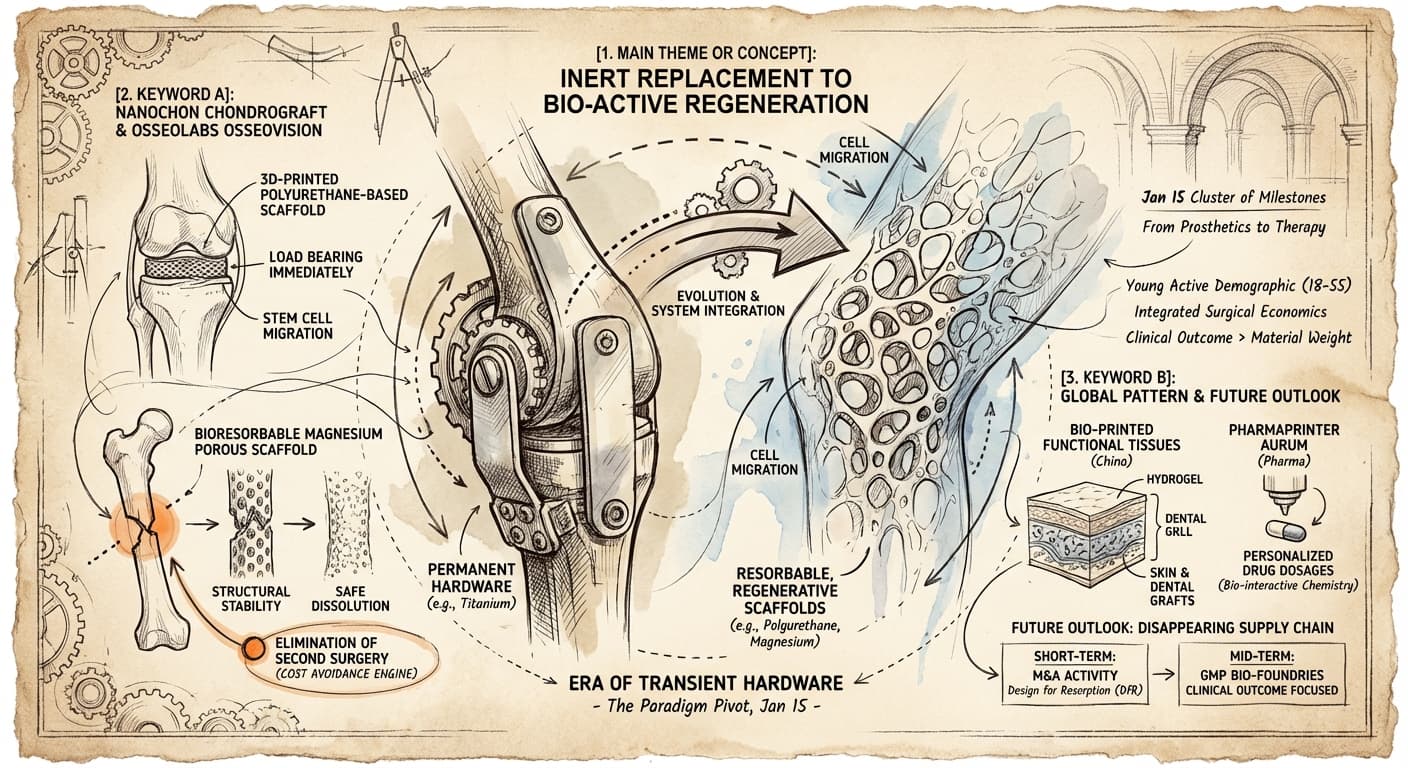
January 16, 2026 – For the last 15 years, the medical additive manufacturing (AM) narrative has been defined by permanence: titanium hip cups, spinal cages, and cranial plates designed to remain in the human body forever. That paradigm effectively ended on January 15. A synchronized cluster of regulatory and financial milestones across the U.S., China, and Europe reveals a fundamental pivot in the sector: the move from Inert Replacement to Bio-Active Regeneration.
While the broader industrial market focuses on metal deposition rates and factory consolidation, the high-margin medical vertical is beginning to cannibalize its own hardware market. The new objective is not to print a part that lasts a lifetime, but to print a scaffold that disappears once the body heals. This shift from permanent metallurgy to resorbable chemistry represents the next great value multiplier for the AM industry.
The Market Signal: First-in-Human Validation
The anchor signal for this transition is the commencement of Nanochon’s first-in-human clinical trials, confirmed on January 15 following a fresh $4.1 million funding injection.
Historically, joint repair has been a binary choice: temporary palliative treatments or total joint replacement with metal and plastic components. Nanochon’s Chondrograft technology disrupts this by introducing a 3D-printed polyurethane-based scaffold. Unlike a solid metal implant, this porous structure is designed to bear mechanical loads immediately while encouraging the patient's own stem cells to migrate and regenerate healthy cartilage.
Why This Matters: This moves AM from a manufacturing method for prosthetics to a platform for therapy. The market implication is profound: it opens the "young active" patient demographic (ages 18–55) which has historically been underserved by total knee replacements due to the limited lifespan of traditional implants. By printing a device intended to eventually be integrated or replaced by natural tissue, Nanochon is effectively creating a new product category between biologics and hardware.
Strategic Deep Dive: The Economics of Resorption
The argument for Bio-Active AM is not just clinical; it is deeply financial. This is best illustrated by OsseoLabs, which also released critical validation data on January 15 regarding its AI-led OsseoVision platform.
OsseoLabs focuses on bioresorbable magnesium porous scaffolds. In current orthopedic trauma standards, metal hardware often requires a secondary surgery for removal-a procedure that affects approximately 25% of routine cases and incurs significant cost and patient risk. OsseoLabs’ printed magnesium implants provide the necessary structural stability for bone knitting and then safely dissolve into the body.
The market value here is not just in the sale of the implant, but in the elimination of the second surgery. This is 'Hardware-as-a-Service' where the service is the calculated disappearance of the product.
The platform’s reported 90% reduction in planning time and 50% shorter operating room stays suggests that the competitive edge in Medical AM is shifting from "printing complex geometries" to "integrated surgical economics." The printer is no longer just a production tool; it is a cost-avoidance engine for hospital networks.
Contextual Synthesis: A Global Pattern
This trend is not isolated to Western startups. A scan of the global data reveals a coordinated push toward bio-integration:
China (HUAQING ZHIMEI): On January 15, this startup secured tens of millions of CNY in Series A funding specifically to industrialize bio-printed functional tissues. Moving beyond structural scaffolds, they are integrating exosome-loaded hydrogels for skin and dental grafts. This bridges the gap between "3D printing" and "Tissue Engineering."
South Korea (Graphy/FUGO): While focusing on orthodontics, the January 13 partnership to mass-produce shape memory aligners represents the high-volume side of this trend. These are biocompatible devices designed to exert force and then be discarded/recycled, moving away from rigid, permanent retainers.
Pharma (CurifyLabs): The January 14 unveiling of the PharmaPrinter Aurum applies this logic to chemistry, printing personalized drug dosages. Again, the focus is on the interaction with the patient's biology, not the durability of the object.
The Convergence: Whether it is cartilage (Nanochon), bone (OsseoLabs), or soft tissue (Huaqing), the industry is collectively moving away from standard materials (PEEK, Ti64) toward bio-interactive feedstocks. The "moat" for medical AM service bureaus is deepening; processing these materials requires far more stringent environmental controls than standard metal sintering.
Future Outlook: The Disappearing Supply Chain
The rise of Bio-Active AM signals a bifurcation in the medical supply chain for the 2026–2030 period.
Short-Term (1-2 Years)
Expect a surge in M&A activity as traditional orthopedics giants (Stryker, Zimmer Biomet, J&J) move to acquire these validated startups. The "permanent implant" market is saturated; growth lies in regenerative solutions. We will see the standard for "Design for Additive Manufacturing" (DfAM) evolve to include "Design for Resorption" (DfR), where lattice thickness is dictated by degradation rates rather than just stress loads.
Mid-Term (3-5 Years)
The service bureau model will face pressure. Printing magnesium or live-cell hydrogels is not compatible with general-purpose job shops. We predict the emergence of "GMP Bio-Foundries"-highly specialized, hospital-adjacent facilities dedicated to transient and regenerative devices. The value of the printed part will decouple from the weight of the material and realign with the clinical outcome: the successful regeneration of the patient.
Stay Updated
Get the latest additive manufacturing (AM) market insights, company updates, and analysis directly in your inbox.
By subscribing, you agree to receive AMPulse emails and to our Privacy Policy. Unsubscribe any time.