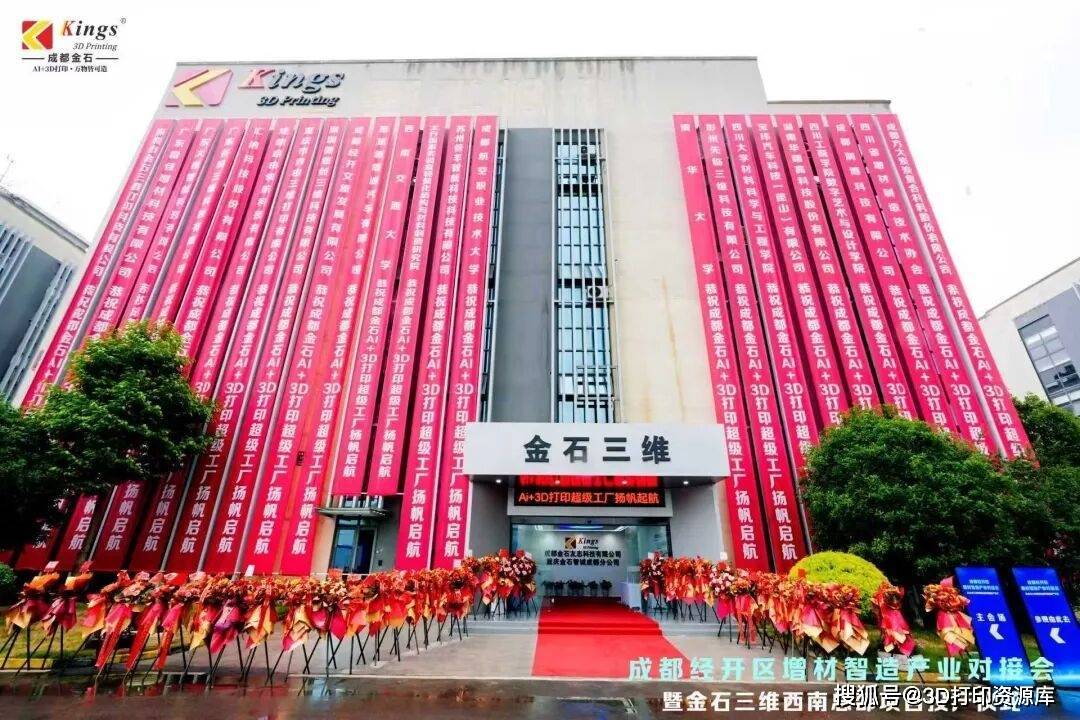
Jinshi 3D Invests 3.5B Yuan in Southwest China Headquarters, Deploys Over 1,000 3D Printers in Chengdu
Originally reported by 3D打印资源库
Jinshi 3D (Jinshi Sanwei) officially launched its Southwest China headquarters in Chengdu on May 15, 2026, with a total planned investment of 3.5 billion yuan (approximately $485 million). The project, operated by the joint venture Chengdu Jinshi Youzhi Technology Co., Ltd., is being built in two phases: Phase 1 at 1.5 billion yuan for R&D, pilot lines, and validation platforms, and Phase 2 at 2 billion yuan for supply chain integration. Currently in transitional production, the facility has already deployed nearly 1,000 3D printing systems across SLM (metal LPBF), SLA, SLS, FGF (large-format pellet extrusion), DLP, and full-color polymer technologies, alongside high-end CNC equipment from DMG MORI, creating a complete development-to-pilot manufacturing chain.
This expansion represents one of the largest single-site AM capacity deployments in China, directly targeting the country's southwestern industrial corridor. Chengdu's Longquanyi district is a major automotive hub hosting FAW-Volkswagen, Volvo, and other OEMs, giving Jinshi 3D immediate adjacency to automotive tooling, functional prototyping, and potential serial-part applications. The company is explicitly prioritizing "AI + 3D printing + aerospace/defense" as its application focus, positioning itself to serve engine components, lightweight structures, and UAV parts for the growing military-civil fusion programs in the region. This aligns with the Chinese localization arc pattern (P2), where a domestic player scales rapidly by integrating multiple process families under one roof and leveraging local government support to build a vertically integrated service ecosystem.
From an expert standpoint, the sheer scale of this deployment - nearly 1,000 machines across seven process families - is less about immediate utilization and more about creating a regional capacity anchor that can absorb demand as Chengdu's aerospace and automotive qualification pipelines mature. The critical execution risk is whether Jinshi 3D can maintain utilization rates above 60% across such a diverse fleet, especially given that SLA and FGF systems face commoditization pressure in China's domestic market. The company's ability to lock in long-term contracts with local OEMs and defense primes over the next 18 months will determine whether this becomes a genuine production hub or an overbuilt service bureau.
Topics