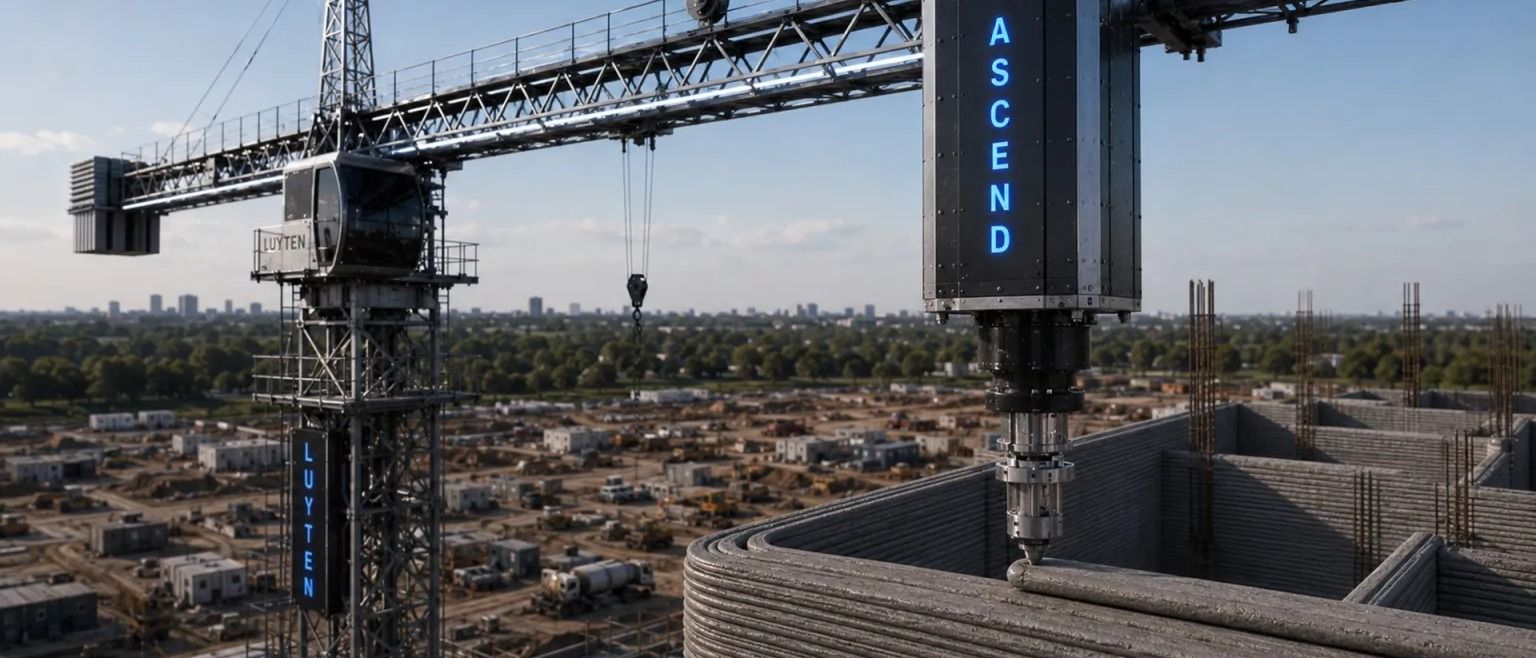
Luyten 3D unveils 'Ascend' tower-crane-type 3D construction printer capable of printing 100m buildings

Service
Originally reported by eyesmag.com
Australian construction technology company Luyten 3D has unveiled the 'Ascend,' a tower-crane-type 3D construction printer that combines a tower crane structure with concrete 3D printing technology. The Ascend is designed to print structures up to 100 meters in height with a maximum working radius of 45 meters, and the company claims setup and operational readiness takes approximately one to two days. Luyten 3D states that the system uses AI to calculate print paths and manage the construction process, reducing labor dependency and material waste. The company describes the Ascend as a concept that transforms a tower crane into a construction robot, positioning it as a step toward broader construction automation.
This development extends the construction 3D printing frontier beyond the typical gantry-frame or robotic-arm systems that dominate the segment. Most construction-scale printers, such as those from COBOD, ICON, or Peri, operate within fixed frames or on rail systems, limiting their vertical reach to roughly 10-15 meters for single-pass structures. Luyten 3D's tower-crane approach addresses a genuine constraint in the construction AM market: the inability to print multi-story buildings without disassembly or repositioning. The 100-meter target height, if validated in commercial settings, would place the Ascend in a different class of capability, potentially opening high-rise residential or commercial tower applications that have remained largely theoretical in the construction AM space. However, the company has not disclosed material specifications, layer resolution, reinforcement integration methods, or regulatory pathway details, which are critical for real-world adoption in code-governed construction markets.
For Luyten 3D, the immediate challenge is moving from a prototype unveiling to a validated, code-compliant production system. Construction AM has a long history of impressive demonstrations that stall at the permitting and insurance stage. The company needs to demonstrate not just height capability but also structural integrity, reinforcement integration (rebar or post-tensioning), and compliance with local building codes in its target markets. Buyers should treat the 100-meter claim as an aspirational specification until independent third-party testing and certified project references emerge.
This article is an AI-assisted rewrite of the linked source report. Facts originate from the source; phrasing is AMPulse's. Use Read Original below to verify, or Report an issue if something is wrong.
Topics