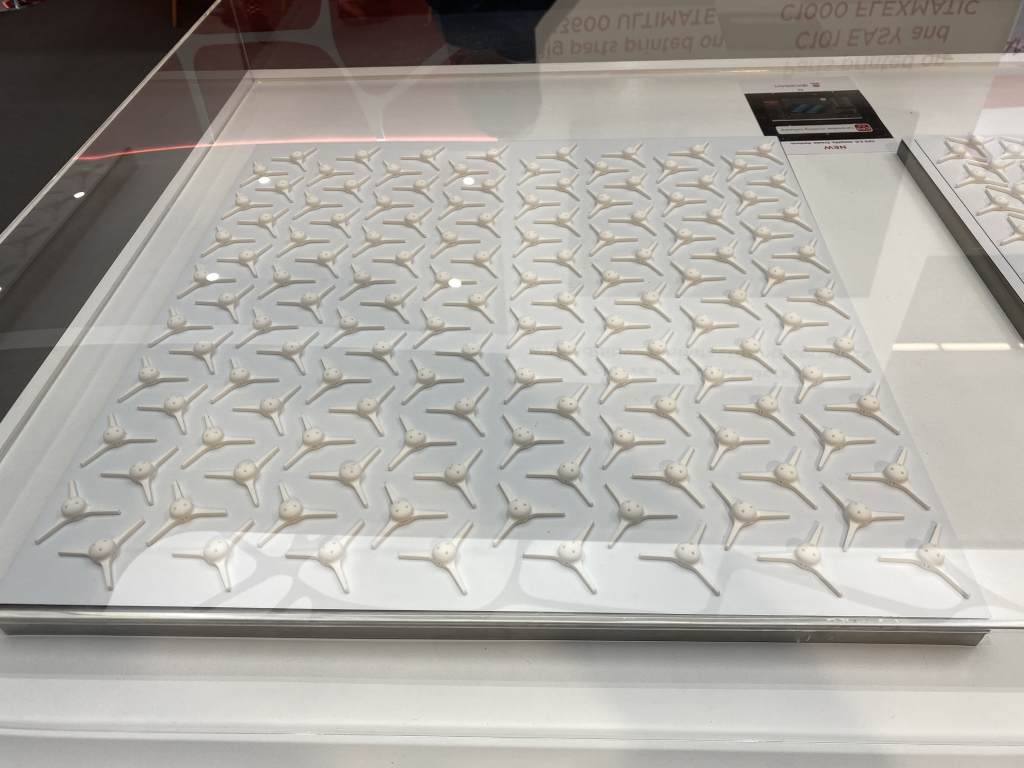
3DCeram Sinto develops ceramic 3D printed SOEC components for hydrogen systems

Hardware
Originally reported by 3D Printing Industry
3DCeram Sinto, the France-based ceramic additive manufacturing specialist, is advancing solid oxide electrolysis cell (SOEC) technology through the HYP3D project, targeting improved hydrogen production and energy storage. The company applies its stereolithography (SLA) process, using a top-down approach with low-viscosity ceramic slurries, to produce corrugated zirconia 8Y cells with thicknesses of 250–300 µm. These additively manufactured cells increase reactive surface area by approximately 60% compared to conventional flat designs and withstand pressure differentials up to 1,100 millibars, versus the roughly 40 millibar failure threshold of tape-cast or screen-printed membranes. Early tests have achieved current densities of approximately 450 mA/cm², with ongoing work addressing contact losses and system integration for industrial-scale deployment.
This development sits within the broader energy-sector push to scale electrolysis for green hydrogen, where material limitations and system complexity have historically constrained adoption. Conventional SOEC systems require complex pressurized vessels to manage pressure sensitivity, adding cost and limiting scalability. By enabling corrugated geometries that eliminate the need for external pressure vessels and simplify metallic interconnects to flat components, 3DCeram Sinto's approach directly addresses the qualification and reliability challenges that have kept ceramic AM in the research-academic and early-industrial phases. The work aligns with the aerospace qualification grind pattern, where material and process validation for demanding environments takes years, but the payoff is embedded supply-chain position. The company's focus on zirconia 8Y - a material selected for ionic conductivity, chemical stability, and thermal resistance - positions it against incumbent ceramic processing methods like tape casting, which lack geometric freedom, and against other ceramic AM players such as Lithoz and Admatec, which use similar vat photopolymerization routes but target different applications.
For 3DCeram Sinto, the practical next step is scaling manufacturing throughput to support industrial hydrogen systems while maintaining dimensional stability across large-area components. The HYP3D project has already demonstrated validated designs across multiple machine platforms and stack configurations, but contact losses and system integration remain open engineering problems. This is not a breakthrough announcement - it is a methodical materials and process development effort that, if successful, could open a new production route for SOEC stacks in the energy vertical. The company must now prove repeatability and cost parity with conventional manufacturing at volume, which is the same grind every ceramic AM entrant faces when moving from lab-scale to qualified production.
Topics