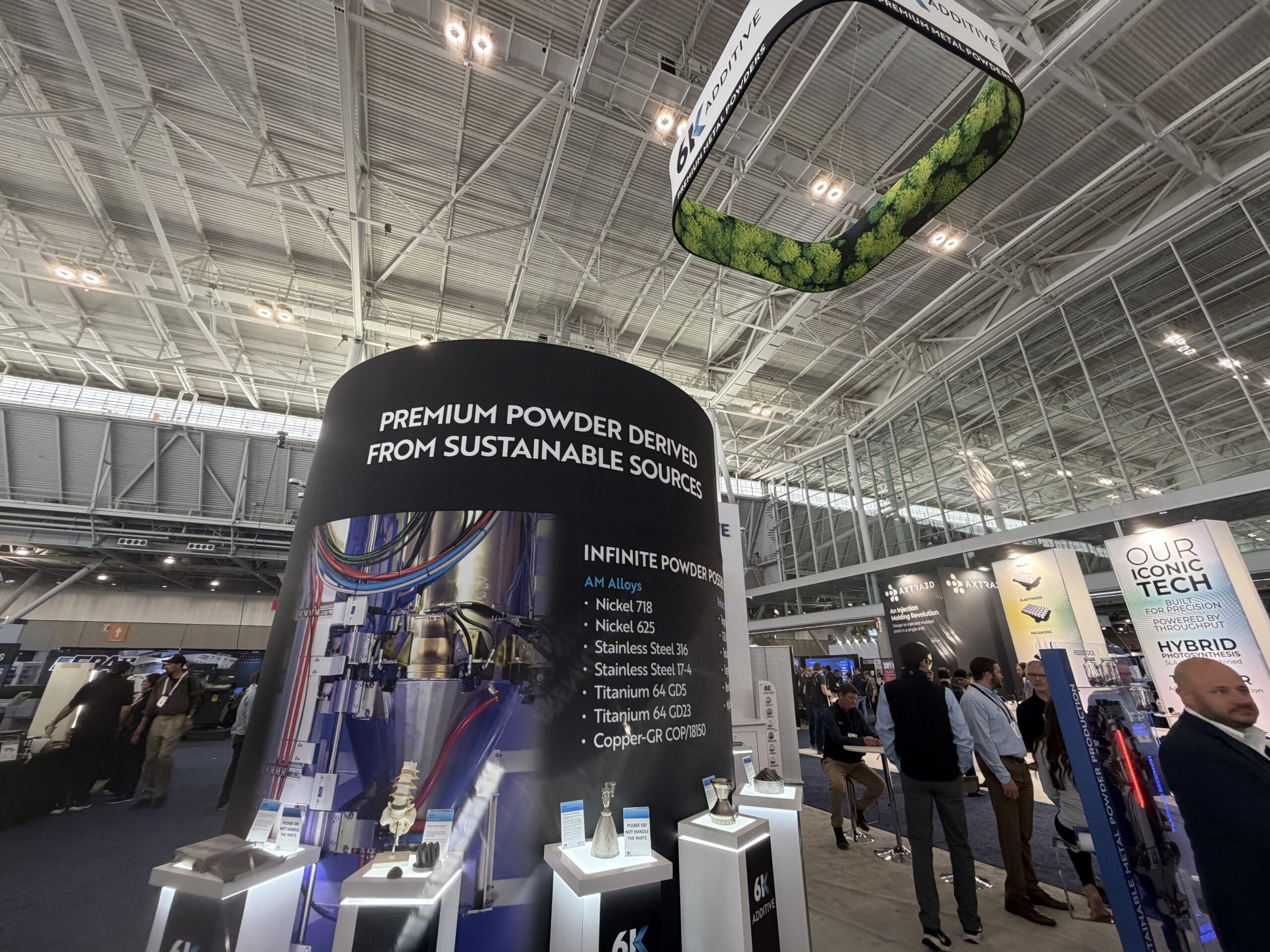
6K details domestic metal powder strategy and consolidation plan at RAPID 2026

Materials
Originally reported by 3DPrint.com
6K Additive (ASX: 6KA) used RAPID+TCT 2026 in Boston to detail its domestic metal powder strategy and post-IPO consolidation plan. CEO Frank Roberts and CMO Bruce Bradshaw outlined the company’s proprietary UniMelt microwave plasma process, which converts U.S.-sourced scrap-turnings, end-of-life components, and depot waste-into premium refractory powders including tungsten, tantalum, rhenium, and niobium. The company recently hosted Congressman Guy Reschenthaler (PA-14) at its Burgettstown, Pennsylvania campus, and disclosed a $1.95 million Phase II modification from the Defense Logistics Agency under its Recovering Strategic Value project, bringing total award value to $3.9 million. 6K will partner with a robotics firm to deploy XRF-based automated sort-and-segregate systems for scrap feedstock qualification.
This announcement lands squarely within the Chinese localization arc (P2) and the broader defense-driven reshoring wave. Roberts highlighted that China controls 80% of ammonium paratungstate (APT), the key tungsten precursor, and recently restricted supply, driving prices sharply higher. Bradshaw noted that 43% of global niobium supply comes from Brazil, but 61% of ownership in those Brazilian producers is Chinese-meaning nominal non-Chinese sourcing often masks de facto dependency. 6K’s claim to truly domestic powder rests on its feedstock: all scrap comes from U.S. sources, unlike competitors who may melt imported bar or wire and still label output as U.S.-produced. The DLA contract and congressional visit signal that 6K is positioning as a strategic supplier for defense applications including hypersonics and nuclear energy, where refractory metals are critical. The company went public on the ASX months ago, and this consolidation narrative-vertical integration from scrap collection through powder qualification-is central to its market thesis.
For buyers of refractory metal powders, 6K’s message is clear: verify the full supply chain, not just the final melt location. The company must now execute on automated scrap sorting at scale and secure qualification pathways for its powders in defense programs. The DLA modification provides near-term revenue visibility, but the long-term test is whether 6K can match the pricing and consistency of incumbent powder producers while maintaining its domestic-origin claim.
This article is an AI-assisted rewrite of the linked source report. Facts originate from the source; phrasing is AMPulse's. Use Read Original below to verify, or Report an issue if something is wrong.