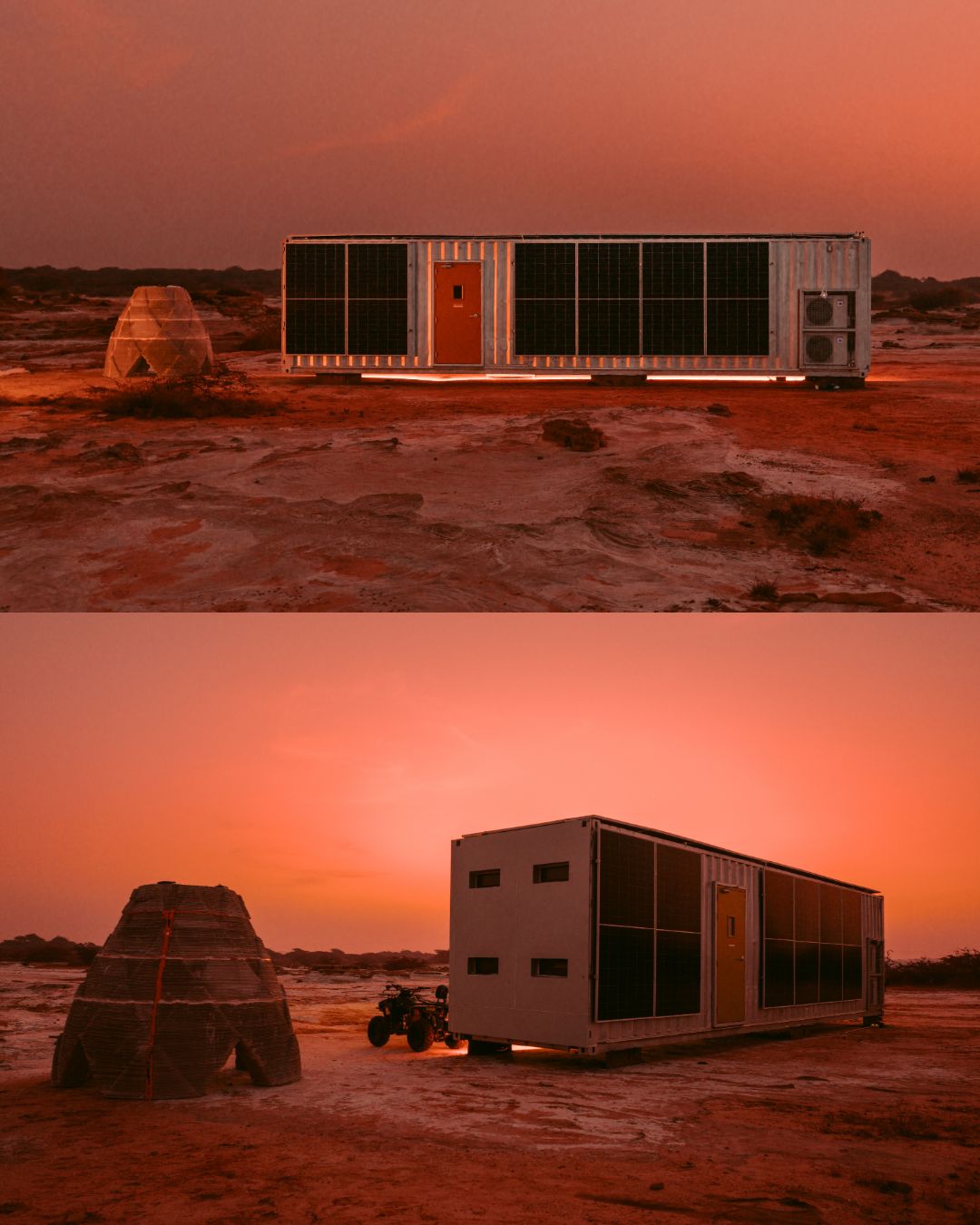
AAKA Space Studio 3D prints basalt radiation shield for Mars missions using low-power process

Application
Originally reported by 3D Printing Industry
Ahmedabad-based AAKA Space Studio has 3D printed a physical radiation shield using a custom-formulated Martian soil analogue, demonstrated at an analog space mission in Gujarat. The shield was fabricated from olivine-rich basalt sourced from Salem and marly limestone from the Ariyalur basin in Tamil Nadu, combined with lime-based binders to create a high-fidelity simulant of Martian regolith. Using MiCoB's MiCO-V concrete 3D printing system, AAKA produced a monolithic structure through autonomous layer-by-layer deposition, achieving both cosmic radiation attenuation and thermal stability across temperature variations. The project was conducted in collaboration with Government Arts College, marking the first indigenous Indian feedstock validated for in-situ resource utilization (ISRU) construction research.
This development directly challenges the prevailing energy-intensive approach to planetary construction, most notably ICON's Olympus system, which relies on laser vitreous multi-material transformation to melt regolith at high power. AAKA's lime-based binder hardens through chemical bonding rather than thermal melting, enabling radiation-resistant monolithic structures at a fraction of the energy load - a critical advantage for early Mars missions where sustained high-intensity power will be scarce. The work also establishes India's first domestically sourced Martian soil analogue, reducing import dependence for ISRU research and positioning AAKA within the broader aerospace qualification grind for planetary surface construction. While still a proof of concept on Earth, the method aligns with the consumer-electronics titanium pull-through pattern of validating materials and processes in terrestrial analogs before space deployment.
For AAKA, the immediate next step is transitioning from analog mission demonstration to a flight-ready qualification program, likely requiring collaboration with a national space agency such as ISRO or NASA to validate the material's performance under actual Martian radiation and thermal cycling. The energy advantage is real, but the path to certified space hardware remains measured in years, not quarters. Buyers in the planetary construction ecosystem should treat this as a promising materials-process combination that still needs environmental testing, not a deployable solution.
Topics