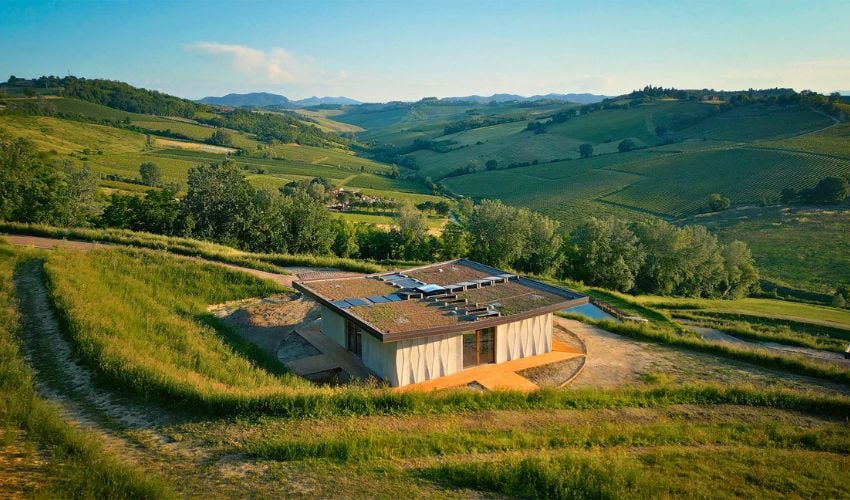
WASP and Olfattiva open Shamballa, a 3D-printed farm and research hub in Italy

Hardware
Originally reported by 3DNatives
On June 8, 2026, Italian construction AM specialist WASP and botanical fragrance company Olfattiva inaugurated Shamballa, a 3D-printed farm and open-air research laboratory in the Emilia-Romagna hills. The centerpiece is Itaca, a self-sufficient farmhouse printed by WASP’s Crane system - a four-armed robotic gantry that completed the structural envelope in two days. Walls are 60–70 cm thick, made from a blend of natural hydraulic lime (NHL) and Geolegante mineral binder, filled with rice husk waste for insulation. WASP states the structure achieves negative CO₂ balance and meets Italy’s stringent seismic codes, positioning it as a replicable model for sustainable construction.
Shamballa represents a rare integration of construction-scale AM with regenerative agriculture and biodiversity research. The Crane WASP system, which uses four synchronized robotic arms anchored to a hexagonal frame, is one of the few large-format extrusion platforms capable of on-site printing with low-carbon mineral binders rather than conventional cement. The project’s seismic certification in Italy - home to some of the world’s strictest building codes - strengthens the case for regulatory acceptance of 3D-printed structures in other earthquake-prone regions. Olfattiva’s adjacent eight-hectare botanical garden, featuring 500 ancient fruit trees and 50,000 aromatic plants, adds a living research component focused on agroforestry and biodiversity restoration. This dual-use model - production building plus active R&D site - is uncommon in construction AM, where most projects remain single-purpose demonstrations.
For WASP, Shamballa is a practical proof point for its Crane platform’s ability to deliver code-compliant, carbon-negative structures using locally sourced waste materials. The company’s next challenge is translating this single-site success into repeatable commercial projects, particularly in markets where building codes and material supply chains differ. For the broader construction AM segment, the project demonstrates that regulatory hurdles - especially seismic certification - are surmountable with the right material formulation and print strategy, but scaling beyond bespoke farmhouses will require standardized material supply and faster permitting pathways.
Topics