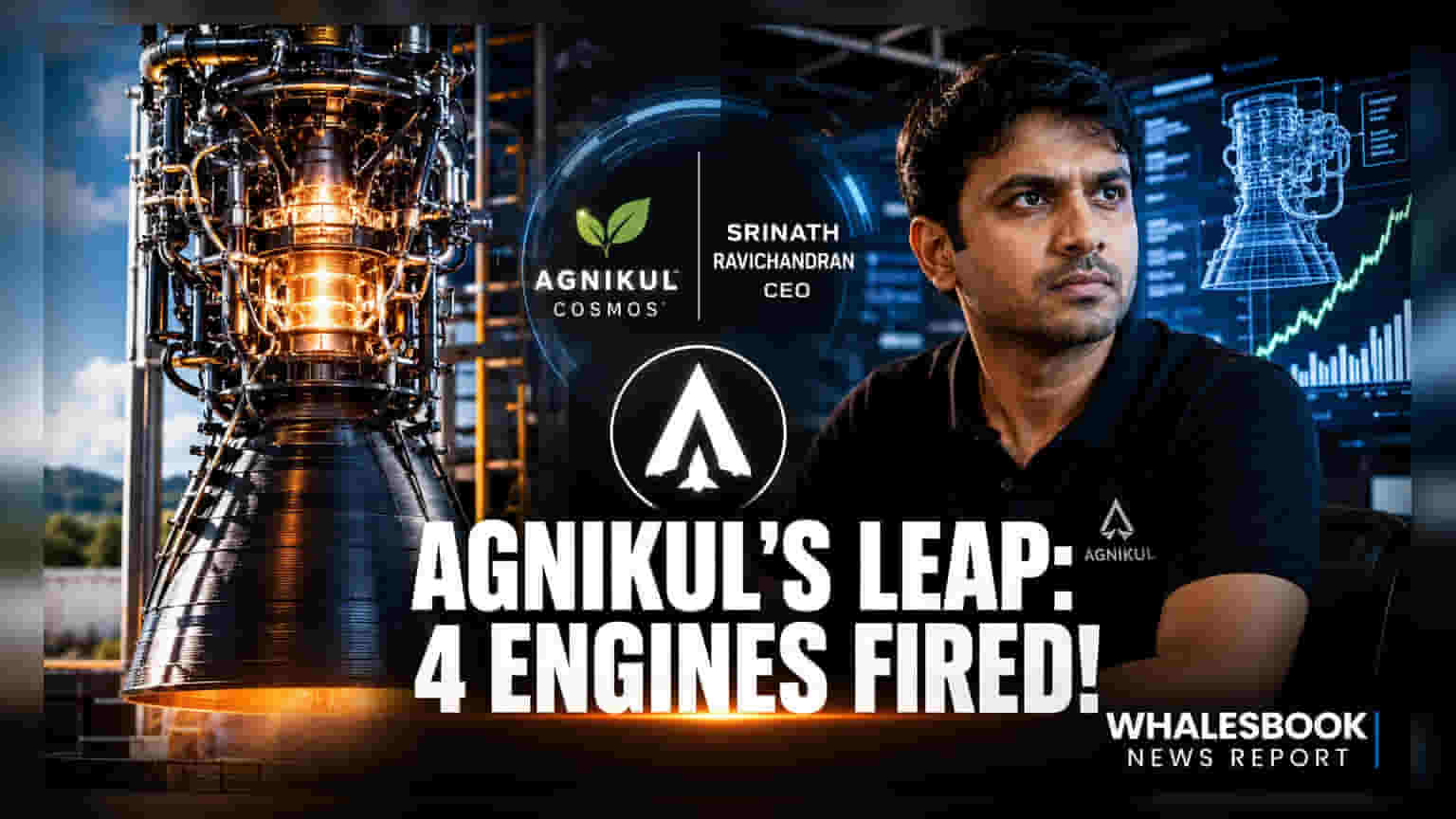
Agnikul Cosmos Validates Multi-Engine Clustering for 3D-Printed Rocket, Targets 2026 Orbital Flight

Hardware
Originally reported by Whale's Book
Agnikul Cosmos has successfully validated multi-engine clustering technology for its 3D-printed Agnilet engines, synchronizing four engines with eight electric pumps and independent control algorithms in a static fire test. The Indian startup, headquartered in Chennai, aims to leverage this modular architecture - configurable from four to seven engines - to deliver mission-specific small-satellite launches from its Rocket Factory-1 facility. The company prints its single-piece engines in seven-day cycles using laser powder bed fusion (LPBF), targeting a maiden orbital flight by late 2026. This milestone de-risks the transition from ground testing to orbital delivery, though the company carries a valuation exceeding $500 million and remains dependent on venture capital and state government support.
This development updates the aerospace qualification grind pattern, where AM success in propulsion components moves from engineering validation to production infrastructure. Agnikul’s vertical integration - in-house LPBF engine production, engine design, and launch operations - mirrors the value-chain capture strategy seen in Western new-space firms like Relativity Space, but at a smaller payload scale. The company competes directly with Skyroot Aerospace in India’s nascent private launch sector, and faces the same high-failure-rate environment that has claimed multiple small-launch startups globally. The modular engine architecture addresses a genuine market gap: satellite operators seeking precise orbital placement and time-sensitive windows, rather than rideshare cost-per-kilogram economics. However, the forensic bear case remains that single-piece 3D-printed engines introduce material fatigue risks only discoverable during actual launch vibration and thermal cycling, presenting binary technical risk.
From an AM industry perspective, the practical next step is not the orbital flight itself but the vacuum-environment staging test that will reveal whether LPBF-printed Inconel or similar superalloy structures can survive the thermal and mechanical loads of stage separation. Agnikul must demonstrate that its seven-day print cycle produces engines with consistent material properties across multiple builds, not just single-unit prototypes. For the small-launch market, this validation would prove that AM can deliver the rapid turnaround and mission flexibility that legacy machining cannot, but only if the company survives the capital-intensive transition from static fire to orbit.
This article is an AI-assisted rewrite of the linked source report. Facts originate from the source; phrasing is AMPulse's. Use Read Original below to verify, or Report an issue if something is wrong.
Topics